Cleared Is Not Covered: RAPID and the Fight to Close America's Coverage Gap
On 27 October, AdvaMed publicly restated the changes it wants in CMS's proposed RAPID pathway — the plan to issue a Medicare coverage decision 60 to 90 days after FDA authorisation instead of a year or more later. The argument is no longer about speed of approval. It is about whether approval and payment finally move together.
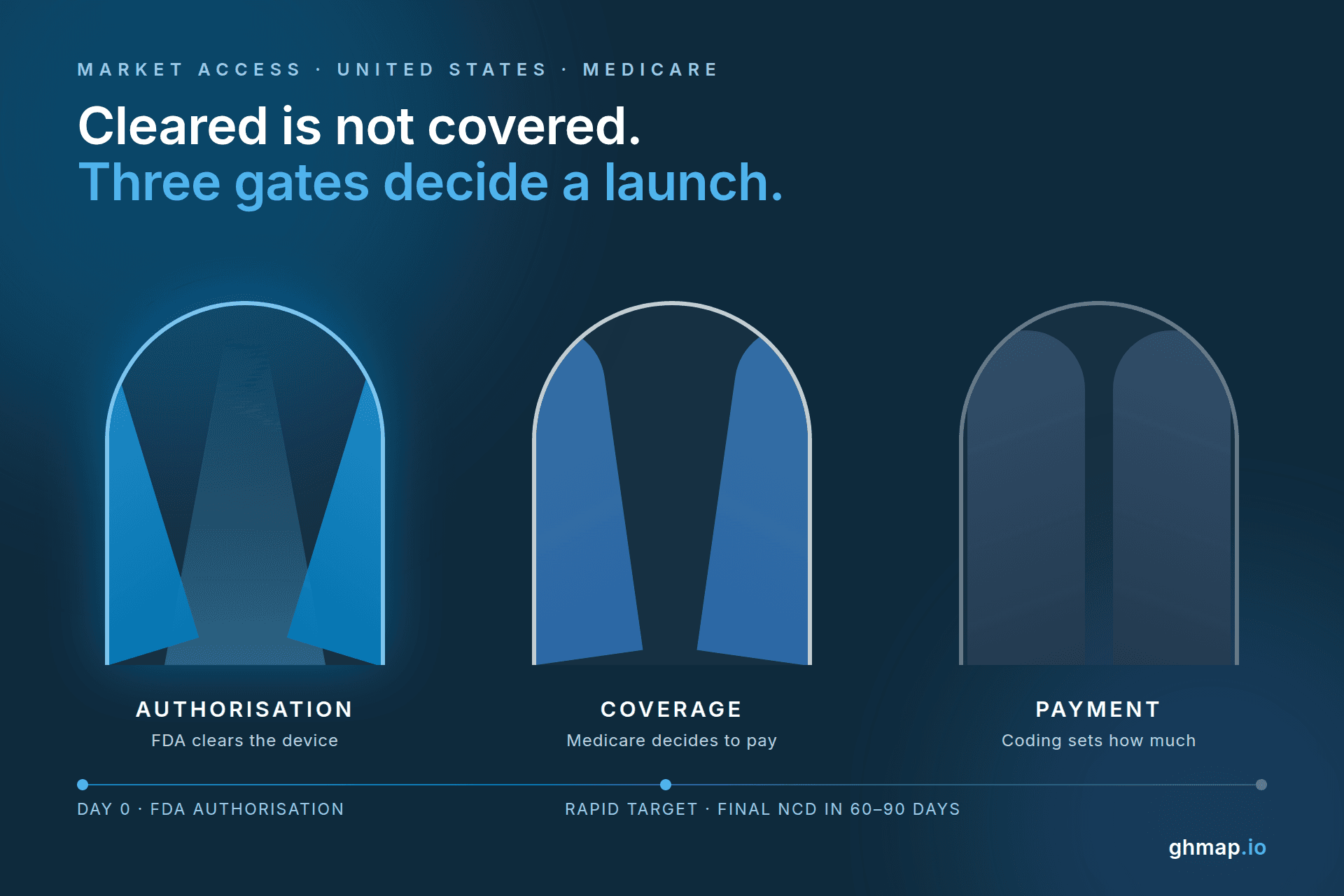
FDA authorisation has never been the finish line in the United States. A device can be cleared or approved and still wait — for a coverage decision that says Medicare will pay, for a code that lets a hospital bill, and for a payment level that makes adoption viable. That sequence is where many launches stall.
RAPID — Regulatory Alignment for Predictable and Immediate Device — is CMS and FDA's latest attempt to compress it. Announced jointly on 23 April 2026 and published as a proposed procedural notice on 11 August 2026 (CMS-3487-NC, comments closed 13 October), it remains a proposal, not a final pathway. This week, the industry's main trade body put its conditions for making it work on the public record.
What RAPID would actually change
Traditionally, CMS starts a National Coverage Determination (NCD) only after FDA authorisation — a process that typically takes nine to 12 months or longer. Under RAPID, CMS and FDA would work with a manufacturer during premarket development, starting at the Investigational Device Exemption (IDE) stage, to align the evidence both agencies need. CMS would release a proposed NCD on the same day as FDA authorisation, with a final NCD about 60 days later for eligible Class II devices and about 90 days later for Class III.
Two limits define the offer. Coverage is not automatic: the NCD still goes through public comment and CMS retains discretion. And eligibility is narrow — FDA-designated Breakthrough Devices only, in an IDE study enrolling Medicare beneficiaries with outcomes agreed by both agencies. All qualifying Class III devices could enter; Class II devices must also be in FDA's Total Product Life Cycle Advisory Program (TAP). In vitro diagnostics are excluded as drafted.
What AdvaMed asked for on 27 October
AdvaMed's 27 October announcement summarised its 8 October comment letter. Its seven asks: resource RAPID properly, transparently and in line with FDA's risk-based framework; broaden eligibility; avoid unnecessary procedural barriers; allow appropriate participation by diagnostics; set firm NCD timelines; coordinate coverage, coding and payment; and protect technologies already developed under previous pathways.
The transition point matters. CMS intends to pause the Transitional Coverage for Emerging Technologies (TCET) pathway for new candidates while it implements RAPID. A device developed for TCET — too advanced to have designed its trial around RAPID's new steps — could fall between the two systems. AdvaMed's letter asks for a transitional route judged on whether existing evidence meets RAPID's substantive objectives, not on steps that did not exist when its trial began.
"Medicare beneficiaries shouldn't have to wait for FDA-authorized breakthrough technologies that could improve their health and even save their lives," AdvaMed president and CEO Scott Whitaker said in the release.
Coverage is only one of three payment questions
A faster NCD alone does not solve market access. Coverage answers whether Medicare pays. Coding answers how a provider bills. Payment answers how much — and whether a hospital can adopt the device without losing money on each case.
That distinction is live now. Separately, CMS has proposed repealing the alternative New Technology Add-On Payment (NTAP) pathway that let Breakthrough Devices receive hospital add-on payments without demonstrating substantial clinical improvement. A device could gain faster coverage under RAPID while facing a higher bar for the add-on payment that supports adoption. Planning one without the other is how a "covered" product still fails to be used.
Why this matters outside the United States
RAPID is a U.S. Medicare proposal; it will not transfer directly to Europe, Africa or the Middle East. The lesson does. In every market, the evidence that wins approval and the evidence that wins adoption and payment are related but not identical — different populations, endpoints and decision-makers.
RAPID's design admits that openly: bring the payer into trial design at the IDE stage, enrol the population the payer covers, and agree outcomes before the pivotal study runs, rather than discovering a coverage gap after authorisation. That is the same discipline manufacturers need elsewhere — hospital evaluation, clinician acceptance and procurement evidence built into the entry plan from the start, not appended after a certificate arrives.
What market entrants should take from this
If you hold or are seeking Breakthrough designation, check RAPID eligibility now — device class, TAP status, IDE design and Medicare-beneficiary enrolment decide it, and those cannot be retrofitted cheaply. Diagnostics makers should plan on existing routes: RAPID as drafted excludes IVDs, and Parallel Review remains available. For any U.S. launch, model three timelines separately: FDA authorisation, coverage, and coding and payment. RAPID, if finalised, could shorten the second. It does not abolish the third.
Authorisation opens the door. Coverage, coding and payment decide whether anyone walks through it.
Sources
- Endovascular Today, "AdvaMed Submits Recommendations to CMS to Strengthen RAPID Coverage Pathway," 27 October 2026.
- AdvaMed, "AdvaMed Recommends Steps to Strengthen RAPID Pathway for Breakthrough Medical Technologies," October 2026 — announcement and Scott Whitaker quote.
- AdvaMed, comment letter to CMS on the RAPID notice, 8 October 2026 (PDF).
- ADVI, "CMS Proposes RAPID Coverage Pathway for Breakthrough Devices" — proposed notice 11 August 2026, comment deadline 13 October 2026, eligibility and IVD exclusion.
- Latham & Watkins, "CMS and FDA Announce New RAPID Program for Medicare Coverage of Breakthrough Medical Devices" — 23 April 2026 joint announcement, TCET pause, 60–90 day target, NTAP alternative-pathway repeal proposal.
- MedTech Dive, "Medtech lobby seeks broader device eligibility for CMS' proposed RAPID pathway," 9 October 2026.
Next step
If you want to model your U.S. launch on three separate timelines — FDA authorisation, Medicare coverage, and coding and payment — book a ghmap.io strategy session. Sessions are planning conversations, not filing services or approval guarantees.
Book a strategy session