
CE Mark vs. FDA 510(k): Which Path Should a Medical Device Company Choose First?
A practical comparison of the European CE Mark path under EU MDR and the U.S. FDA 510(k) clearance route—so small and mid-size manufacturers can choose a first market with clearer trade-offs.
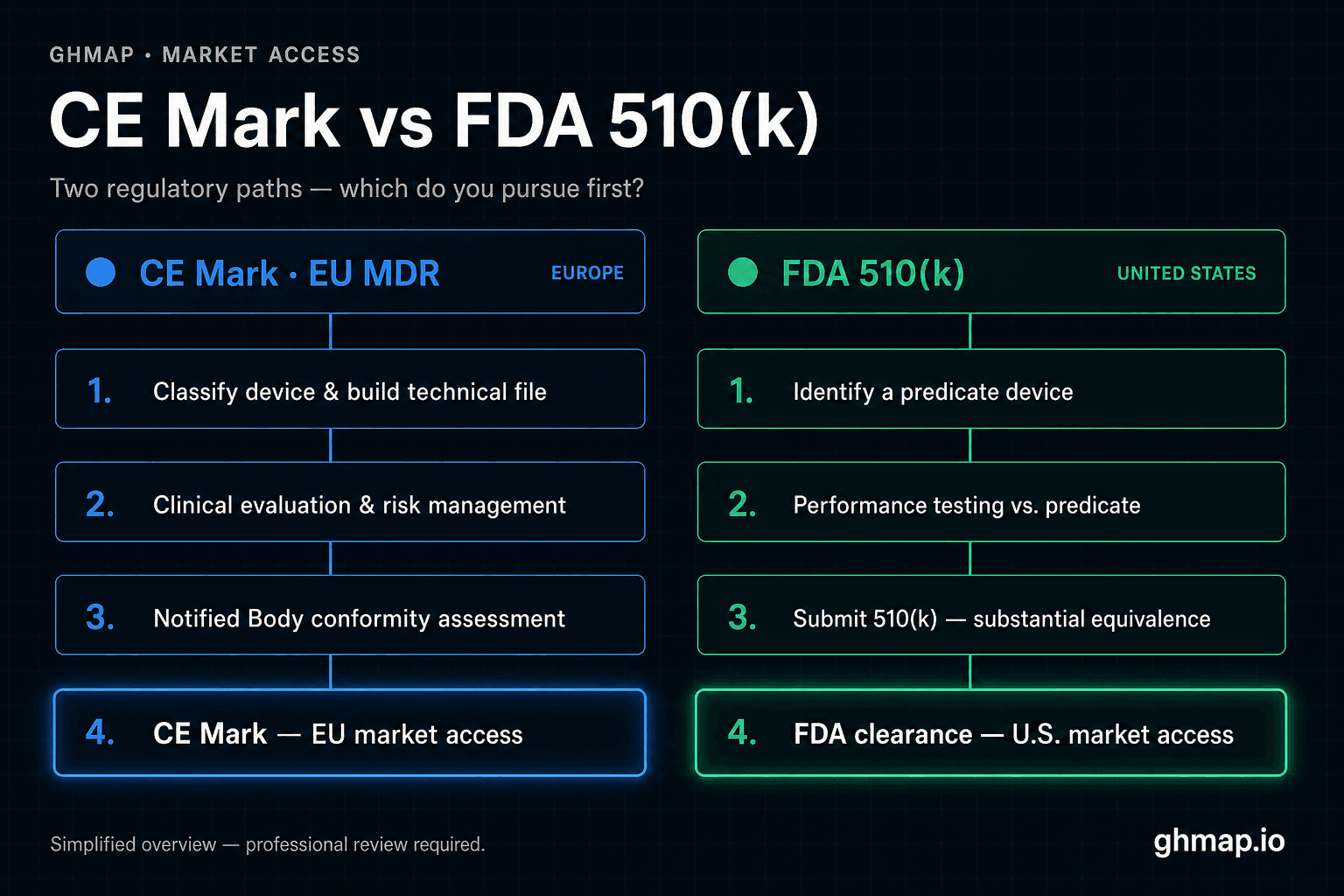
For many small and mid-size medical device manufacturers, the first international regulatory choice is not abstract strategy—it is cash, calendar, and sequencing. The most common fork in the road is CE Mark vs FDA 510(k): pursue European access under the European Union Medical Device Regulation (EU MDR), or pursue United States clearance through a 510(k) submission to the U.S. Food and Drug Administration (FDA).
Neither path is universally “easier.” They optimize for different markets, evidence expectations, and commercial realities. This article explains what each path actually is, compares typical ranges (not guarantees), and offers a practical decision framework. For pathway overviews by certification type, see GHMAP’s certifications library at GHMAP certifications library. For country-and-class registration overviews, see the EU MDR Class IIa pathway at GHMAP regulatory pathways/european-union/class-iia and the FDA 510(k) Class II pathway at GHMAP regulatory pathways/united-states/class-ii — illustrative planning pages that require professional review before business use.
What CE Mark actually is under EU MDR
A CE Mark (Conformité Européenne mark) indicates that a manufacturer claims conformity with applicable European Union (EU) legislation for placing a device on the EU market (and, depending on arrangements, related markets that recognize CE marking). For most medical devices today, that framework is EU MDR—Regulation (EU) 2017/745—which replaced the older Medical Device Directive for many product categories.
Under EU MDR, manufacturers typically build a technical documentation package covering design, risk management, clinical evaluation, labeling, and post-market surveillance plans. For many Class IIa, IIb, and III devices—and for certain Class I devices with measuring function or sterility—conformity assessment involves a Notified Body: an independent organization designated by an EU member state to assess conformity with MDR requirements. Lower-risk Class I devices may follow a more manufacturer-led conformity route, but classification and obligations still need careful confirmation.
In plain terms: CE marking is less “file a form and wait for a stamp” and more “prove a quality system and clinical/performance story that a Notified Body (when required) can assess.” Timelines often depend on Notified Body capacity, dossier completeness, and how novel or high-risk the device is—variables that make fixed promises unreliable.
What FDA 510(k) actually is
A 510(k) is a premarket notification submitted to the FDA for many Class II devices (and some Class I / Class III edge cases defined by regulation). The core claim is substantial equivalence: your device is as safe and effective as a legally marketed predicate device—an existing device already cleared or otherwise legally marketed that you use as a comparison baseline.
If FDA agrees, the outcome is clearance (not “approval,” which in FDA vocabulary usually refers to other pathways such as Premarket Approval, or PMA). A clean 510(k) strategy depends heavily on choosing the right predicate, aligning indications for use, and preparing performance testing that addresses differences between your device and the predicate.
510(k) can look faster than MDR on paper when a strong predicate exists and testing is bounded. It can stall when the predicate is weak, indications drift, software or materials raise new questions, or FDA requests additional information. Again: pathway selection should be treated as planning, not prophecy.
CE Mark vs FDA 510(k): head-to-head comparison
The table below uses general estimates commonly discussed in industry planning conversations. Actual timelines and costs vary by device class, novelty, clinical evidence needs, Notified Body or FDA workload, and manufacturer readiness. These figures are illustrative ranges for orientation only and require professional review before business use.
| Dimension | CE Mark (EU MDR) | FDA 510(k) |
|---|---|---|
| Regulatory body / assessor | Manufacturer conformity + Notified Body when required (EU MDR) | U.S. Food and Drug Administration (FDA) |
| Typical timeline (general estimate) | Often ~9–24+ months for many Notified Body routes after dossier readiness; simpler Class I routes may be shorter | Often ~3–12+ months from a complete submission for many traditional 510(k)s; additional-information cycles extend this |
| Approximate cost range (general estimate) | Frequently mid–high five figures to low six figures USD all-in for many SMB programs (testing, consulting, Notified Body fees)—wide variance | Frequently low–mid five figures to low six figures USD all-in for many traditional 510(k) programs (testing, consulting, FDA fees)—wide variance |
| Market access context | EU single market (~450M consumers) plus CE-recognizing pathways where applicable | United States (~330M consumers) with distinct reimbursement and hospital procurement dynamics |
| Best-fit scenario (simplified) | Strong EU commercial pull, willingness to invest in MDR documentation rigor, or products where EU reference customers matter first | Clear predicate device, U.S. revenue priority, and a testing plan that can support substantial equivalence |
Complexity is the hidden fourth column. EU MDR often front-loads documentation discipline and clinical evaluation structure. 510(k) often front-loads predicate logic and comparative performance evidence. A company strong in quality systems may find MDR documentation familiar; a company with a near-identical predicate may find 510(k) more direct.
A practical decision framework
Use the questions below as a sequencing tool—not as a substitute for regulatory counsel or a Notified Body / FDA strategy consultant.
Choose CE Mark first if…
- Your earliest paying customers, distributors, or key opinion leaders are in the EU (or markets that commercially expect CE marking).
- Your device lacks a clean U.S. predicate, making 510(k) uncertain or pushing you toward a different FDA route.
- You are prepared to invest in MDR-grade technical documentation and clinical evaluation early—and that investment will also strengthen later market dossiers.
- EU tender, hospital, or distributor conversations are already blocked primarily by CE status.
Choose FDA 510(k) first if…
- The United States is your primary revenue beachhead in the next 12–24 months.
- You can identify a defensible predicate device with well-aligned indications for use.
- Your testing burden looks bounded and fundable, and U.S. reimbursement/coding questions are at least scoped.
- U.S. clinical advisors or pilot sites are ready, and CE demand is still speculative.
Many manufacturers eventually need both. The real decision is order of operations: which clearance or marking unlocks the next dollar of learning—revenue, clinical feedback, or distributor commitment—without exhausting the company.
Common mistakes when choosing a first pathway
- Choosing “the market that sounds bigger” without a named buyer or distributor motion in that region.
- Assuming CE Mark is automatically easier than FDA—or the reverse—without checking classification, predicate availability, and evidence gaps.
- Starting Notified Body or FDA engagement with incomplete design controls, risk files, or clinical evaluation logic.
- Treating blog timelines or peer anecdotes as commitments. Capacity, deficiencies, and testing surprises routinely move calendars.
- Ignoring post-market obligations. Both EU MDR and FDA expect surveillance, complaint handling, and change control after launch.
- Bundling regulatory sequencing with reimbursement fantasy. Clearance or CE marking is not the same as payment or adoption.
How to use this comparison without overconfidence
A useful medical device regulatory pathway discussion separates three layers: (1) legal/regulatory route options, (2) evidence and quality-system readiness, and (3) commercial pull in a specific country. CE Mark vs FDA 510(k) sits mostly in layer one, but your choice should be constrained by layers two and three. If commercial pull is weak in both regions, regulatory spend becomes an expensive form of hope.
If commercial pull is strong in one region and evidence readiness matches that region’s pathway, sequence becomes clearer. Document the assumptions—predicate candidates, device class hypothesis, target countries, and what “first revenue” means—then have them reviewed by qualified professionals before you commit budget.
If you want help turning this general CE Mark vs FDA 510(k) comparison into a product-specific sequencing plan—target country, evidence gaps, and next actions—you can book a $500 GHMAP strategy session at GHMAP pricing. Sessions are planning conversations with clear limits: no approval promises, no clinical advice, and no shortcut around qualified regulatory counsel.
Next step
If you want a product-specific map of CE Mark vs FDA 510(k) sequencing—without treating a blog post as a filing plan—start with a GHMAP strategy session.
Book a $500 strategy session