Honey vs. Superbugs: What the Lab Says About Antibacterial Power
Dr. Ferhat Öztürk's 2025 Antibiotics paper put honey compounds to the test in rigorous antibacterial assays. A look at the lab methods behind honey's antibacterial reputation — and why the antibiotic-resistance era gives this old remedy new relevance.
Antibiotic resistance is one of the defining public-health challenges of this century — and it has researchers re-examining remedies that predate antibiotics by millennia. Dr. Ferhat Öztürk, the biomedical scientist known as “The Honey Professor,” has spent more than a decade putting honey's antibacterial reputation to rigorous laboratory tests: as lead author of a 2025 paper in the journal Antibiotics, and through a Texas screening program that tested local honeys against pathogens including MRSA. ghmap.io covers the field's agenda — companies, products, regulation, and market access — and resistance is quietly reshaping that agenda, changing which products get funded, which get prioritized, and which find hospital buyers.
The 2025 paper
- Lead author: Öztürk, with co-authors Cremers, Kasouati, Moussaif, Johansson, Zouhdi, Touré, and Maroui — “Honey Compounds Exhibit Antibacterial Effects Against Aggregatibacter actinomycetemcomitans JP2,” Antibiotics (2025), 14:887. DOI: 10.3390/antibiotics14090887.
- The target: Aggregatibacter actinomycetemcomitans JP2, a bacterium strongly associated with aggressive periodontitis — a demanding, well-characterized test organism for antibacterial screening.
- The materials: honey compounds and royal jelly, tested side by side.
- The key correlation: honeys with higher hydrogen peroxide and flavonoid content showed stronger antibacterial effects — lower minimum inhibitory concentrations (MICs).
How a lab measures antibacterial power
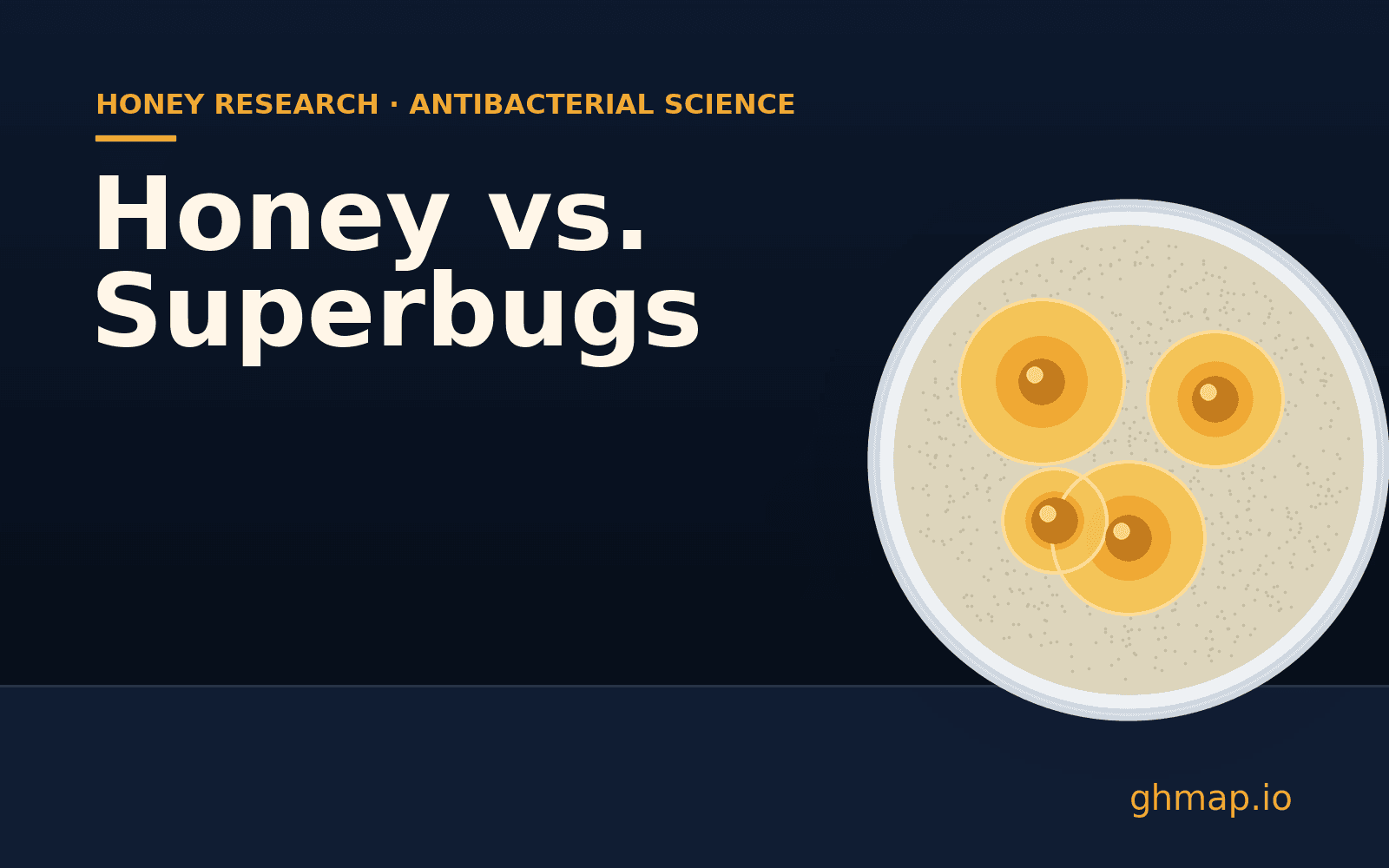
Antibacterial claims mean little without standardized assays. In the lab, researchers expose bacterial cultures to serial dilutions of a test substance and record the minimum inhibitory concentration — the lowest dose that stops visible growth — alongside agar-diffusion tests that reveal clear inhibition zones around a sample. Öztürk's team applied this kind of quantitative screening to compare honey samples head to head, linking chemical composition to antibacterial strength rather than relying on tradition or taste.
Checklist
What the assays actually measure
- Minimum inhibitory concentration (MIC) — the lowest dose that halts bacterial growth
- Inhibition zones — clear rings in agar that visualize antibacterial reach
- Hydrogen peroxide contribution — one of honey's known antibacterial factors
- Flavonoid and phenolic content — plant-derived compounds correlated with potency
- Strain specificity — activity can differ sharply from one pathogen to another
Why the resistance era is watching
Resistant infections are rising worldwide, the antibiotic development pipeline is thin, and hospitals pay a premium for anything that prevents or treats them. Researchers are drawn to honey partly because its antibacterial action is multi-factorial — osmotic stress, hydrogen peroxide, and plant-derived compounds acting together — which makes it an interesting object of study when single-target drugs keep failing. That logic also drove Öztürk's Texas screening work: in 2022 the San Antonio Report described his goal of elevating U.S. honeys to New Zealand's Manuka standard by testing some 60 Texas samples — 35 from San Antonio — against pathogens including MRSA, the drug-resistant Staphylococcus aureus that haunts hospitals. A KSAT 12 television segment the same year showed the bioactivity screening in action.
Frequently asked questions
Checklist
Short answers
- Does the 2025 paper prove honey can replace antibiotics? No. It is laboratory (in-vitro) evidence — a rigorous starting point for research, not a treatment recommendation.
- What is MIC? Minimum inhibitory concentration: the lowest concentration of a substance that visibly stops bacterial growth in the lab.
- What is MRSA, and why test honey against it? Methicillin-resistant Staphylococcus aureus — a drug-resistant bacterium that plagues hospitals; Öztürk's Texas screening included it among its test pathogens.
- Is all honey equally antibacterial? No. Activity varies widely with floral source, processing, and storage — which is why screening and standardization matter.
- How does this connect to market access? Credible lab evidence is step one of the innovation pipeline: it precedes standards, regulatory filings, and every commercial conversation after.
If you are developing an antimicrobial or wound-care innovation and need to understand the path from evidence to market — regulatory routes, distributor channels, reimbursement — a ghmap.io country-intelligence brief maps the terrain. See the link below.
Next step
Developing an antimicrobial or wound-care innovation? ghmap.io country intelligence maps the regulatory pathway, distribution channels, and reimbursement landscape for your first markets — country by country. Planning conversations, not approval services and not outcome guarantees.
Get a market-entry brief