
The Honey Professor: How Medical-Grade Honey Travels From Lab Bench to Wound Bed
Dr. Ferhat Öztürk has spent 12+ years studying honey's antibacterial and wound-healing properties — leading a $2.8M USDA research program, co-authoring peer-reviewed standards for medical-grade honey, and taking the science to a TEDx stage. The science, the standards, and the market path.
Some medical products begin in a chemistry lab. Medical-grade honey began in beehives — and reached modern wound care through researchers willing to test folk medicine with molecular biology. Dr. Ferhat Öztürk, a biomedical scientist known as 'The Honey Professor,' has spent more than twelve years doing exactly that: measuring honey's antibacterial, anti-inflammatory, and antioxidant properties, sample by sample. This is a profile of his work — and of what it takes for a natural substance to become a regulated medical product.
ghmap.io covers the field's agenda: companies, products, regulation, and market access. A scientist generating clinical-grade evidence for a natural product sits at the very start of the innovation pipeline — the point where research must become a product, and a product must find a market. That journey is our field.
The scientist
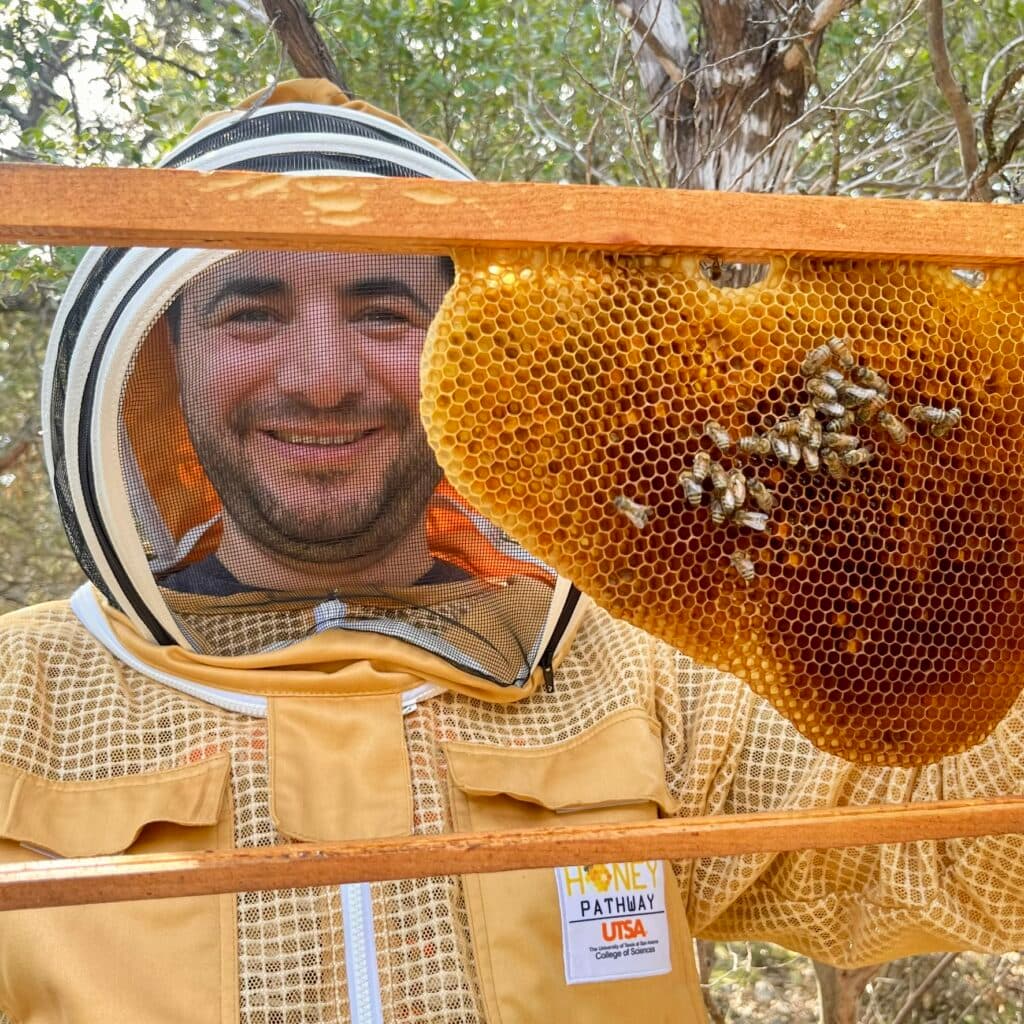
Öztürk earned his Ph.D. in Cellular and Molecular Biology at the University of Nevada, Reno, followed by postdoctoral research at Creighton University and the University of Nebraska Medical Center in cell signaling, wound healing, and bioinformatics. From 2022 to 2025 he taught and researched at the University of Texas at San Antonio (UTSA), where he founded the HONEY Pathway program. In fall 2025 he joined Sul Ross State University International in Eagle Pass, Texas, as Associate Professor of Biology and Founding Program Director of Biology.
The science: peer-reviewed evidence
Three peer-reviewed works anchor the scientific record behind his honey research:
- Lead author, “Honey Compounds Exhibit Antibacterial Effects Against Aggregatibacter actinomycetemcomitans JP2,” Antibiotics (2025) — honey compounds and royal jelly tested against a periodontitis pathogen; hydrogen peroxide and flavonoid content correlated with antibacterial strength. DOI: 10.3390/antibiotics14090887.
- Co-author, “Medical-grade honey: its definition and refined standards,” Journal of Wound Care (2025) — a consensus paper defining what “medical-grade” actually means: organic production, gamma sterilization, clinical safety benchmarks, and physicochemical criteria. DOI: 10.12968/jowc.2024.0206.
- Lead author, “A Systematic Review of Honey's Benefits for Burn Wound Treatment” (2024 book chapter) — 38 studies from 2013–2024: faster recovery, reduced infection, improved scar formation.
In 2022 the San Antonio Report covered his goal of elevating U.S. honeys to the level of New Zealand's Manuka — testing some 60 Texas samples against pathogens including MRSA. A KSAT 12 television segment the same year showed the bioactivity screening in action.
The program: HONEY Pathway
HONEY — “Honeybee Oriented Nextgen Entrepreneurs and Youth” — is the USDA NIFA NEXTGEN-funded program Öztürk founded and directed at UTSA. In June 2023 the U.S. Department of Agriculture awarded $2.8 million over five years to train urban beekeepers, open USDA career paths for underrepresented students, and run medicinal-honey research with student scientists. (Some UTSA pages round the figure to $2.9M; the university's official announcement states $2.8M.) The program has mentored more than 70 student scientists and analyzed over 500 honey samples for bioactivity.
The stage
In 2025 Öztürk took the science to a TEDx stage — “Honey A Sweet Medicine” (TEDxSST Corpus Christi Youth) — tracing honey from ancient medicinal use to modern antibacterial science. His professional site, thehoneyprofessor.com, collects his lessons, medicinal-honey resources, and consulting work.
The product category: honey becomes a medical device
Here the story crosses from science into ghmap.io's territory: regulation. Honey-based wound dressings are regulated as medical devices, cleared through the FDA's 510(k) pathway under product code FRO (“Dressing, wound, drug”). The U.S. precedent line is MEDIHONEY (Derma Sciences, now Integra LifeSciences): early clearances K072956 and K080315, a hydrogel sheet dressing cleared July 27, 2011 (K110546), and a calcium alginate variant cleared June 25, 2015 (K133279) with indications including diabetic foot ulcers and partial-thickness burns. A January 2025 review counted more than twenty FDA-cleared honey-based wound products.
Checklist
What makes honey “medical-grade” (2025 consensus)
- Gamma sterilization (ISO 11137) that preserves bioactivity
- Organic production and traceable sourcing
- Documented clinical safety benchmarks
- Physicochemical criteria — measured antibacterial activity, not just sweetness
The category carries discipline lessons too: in 2025 the FDA logged Class II recalls of MediHoney gel and hydrogel sheet dressings over packaging and sterile-barrier defects — a reminder that in wound care, manufacturing quality is clinical quality. Meanwhile the EU's Medical Device Regulation is raising the evidence bar for natural-product devices, a shift the 2025 consensus paper explicitly discusses.
The market-access lens: from molecule to market
Step back and the pattern is familiar to anyone in market access. A researcher generates evidence. A consensus defines the standard. A regulatory pathway — 510(k), product code FRO — turns the substance into a product. Then come distributors, hospital pilots, and reimbursement, each with its own calendar. Vendor research firms estimate the medical-grade honey dressings market at roughly $135M in 2025, growing toward about $220M by 2032 (estimates vary by vendor) — a market small enough that channel quality and clinical champions decide the winners.
That is the innovation pipeline ghmap.io exists to map: the distance between a discovery in Eagle Pass, Texas, and a dressing on a hospital shelf in Berlin, Riyadh, or Nairobi. Science opens the door; market access walks through it — country by country, document by document.
If you are bringing a wound-care or natural-product innovation toward a first market — first clearance, first distributor, first hospital pilot — a ghmap.io strategy session maps your stages. See the booking link below.
Next step
Bringing a wound-care or natural-product innovation toward a first market? A ghmap.io strategy session maps your stages — pathway, documentation, channel, and payment. Planning conversations, not approval services and not outcome guarantees.
Book a $500 strategy session