
What Is a Certificate of Free Sale, and Why Does Your Export Deal Depend on It?
A Certificate of Free Sale (CFS) is often requested late in an export deal. This guide explains what a CFS proves, who typically issues it, how it differs from CE or ISO certificates, and why lead time matters.
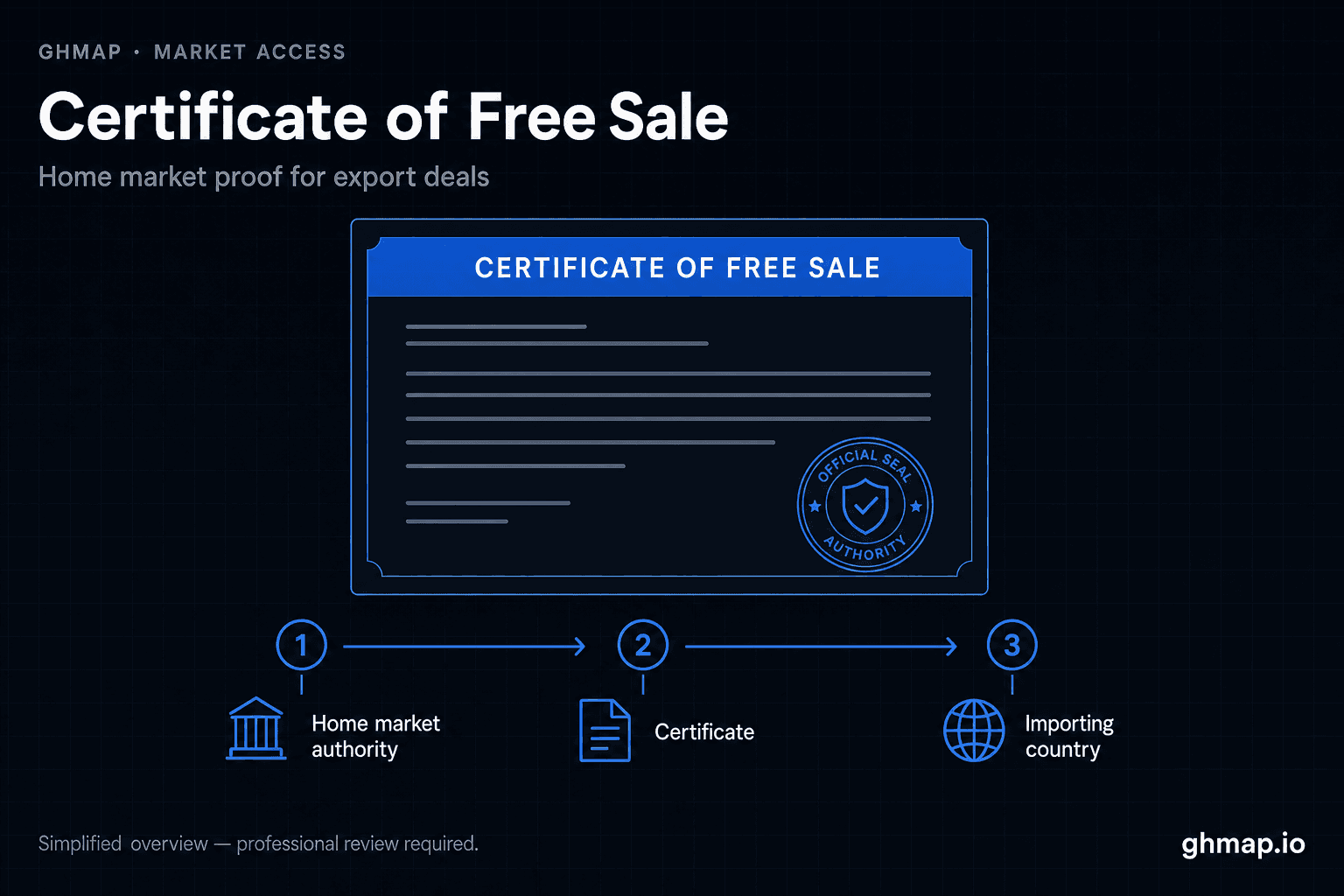
The deal looks ready. The distributor has samples. The importer has a timeline. Then someone asks for a Certificate of Free Sale—often abbreviated CFS—and everything pauses. The request usually arrives as if everyone already knows what it is. Many small and mid-size manufacturers do not. They scramble, send the wrong document, or discover the lead time is longer than the purchase order window.
This article explains what a Certificate of Free Sale medical device exporters are usually being asked for, what it proves, how it differs from related papers, and why waiting until the last week is expensive. It is general orientation. Issuing bodies and free sale certificate requirements vary by country and must be confirmed locally. Professional review is required before business use.
What is a Certificate of Free Sale?
In plain language, a Certificate of Free Sale is an official statement that a product is legally marketed—or free for sale—in its home (or reference) market under the rules of that jurisdiction. Importers and authorities use it as evidence that the product is not an unregulated or blocked item in the country where it is already sold.
Names and formats vary. Some markets say “Certificate of Free Sale,” others use close equivalents. The common idea is home-market legitimacy, not a universal passport that replaces the importing country’s own registration or conformity rules.
What it proves, and who issues it
A CFS typically speaks to market status in the issuing country: that the named manufacturer/product is allowed to be sold there, subject to local definitions and the certificate’s exact wording. It does not, by itself, approve the product for every destination market.
Who issues it depends on the country. In some places a competent authority—the government body that oversees medical devices or health products—issues or endorses the document. In other places a chamber of commerce or another designated body issues a form that importers accept for trade purposes. Do not assume the same issuer works everywhere. Confirm the accepting country’s preference and the home country’s process before you promise a date.
Why importing countries ask for it
Importing authorities and distributors often want proof that the product is already sold under regulation at home. A CFS is a compact way to ask: “Is this a real commercial medical device in its origin market, or a paper-only export story?” For medical device export documents packages, that question sits beside labeling, registration dossiers, and quality evidence.
If you are building a broader export path—especially from a non-EU base into Europe—pair document planning with pathway planning. Turkish manufacturers mapping CE Mark work under the European Union Medical Device Regulation (EU MDR) can start with Turkish manufacturer EU market entry guide, then return here when a buyer’s CFS request becomes the critical-path item.
CFS vs. the documents people confuse it with
Confusion wastes weeks. Teams send a CE certificate when the importer asked for a CFS, or an ISO certificate when the authority wanted home-market free-sale proof. Use the table as a planning lens. Exact acceptance rules still vary by jurisdiction.
| Document | What it typically proves | Who typically issues it |
|---|---|---|
| Certificate of Free Sale (CFS) | That the product is legally marketed / free for sale in the home or reference market, per the certificate’s wording | Often a competent authority, chamber of commerce, or other designated body—varies by country |
| CE certificate / CE-related conformity evidence | That applicable European conformity assessment steps were completed for CE marking under the relevant EU framework (for example EU MDR routes) | Often a Notified Body for routes that require one; manufacturer declarations also play a role depending on class/route |
| Certificate of Origin | Where goods are considered to originate for customs/trade preference purposes | Typically customs-related or chamber processes defined by trade rules—not a medical-device safety approval |
| ISO 13485 certificate | That a quality management system was audited against ISO 13485, the medical-device quality management standard | An accredited certification body—not usually a substitute for a CFS |
For pathway overviews by certification type, see GHMAP’s certifications library at GHMAP certifications library. A CE Mark (Conformité Européenne mark) conversation and a CFS conversation can both be necessary—and still answer different questions.
How to obtain a CFS (general steps)
Processes differ, but the work usually follows a familiar pattern:
- Confirm the destination country’s exact document name, language, legalization/apostille needs, and accepted issuing bodies.
- Confirm that your product is actually eligible for a home-market free-sale statement—registered, listed, or otherwise legally marketed as required locally.
- Assemble the supporting pack the issuer requests: product identifiers, manufacturer details, copies of local registrations or certificates, and authorized signatures.
- Submit to the correct issuing body and track validity dates, product scope, and whether the certificate names the exact model/configuration you will ship.
- Plan legalization, notarization, translation, or embassy steps if the importer requires them—these often add more calendar than the certificate draft itself.
Lead time matters because CFS requests often appear after commercial terms feel “done.” If the certificate takes weeks and the shipment window is days, the deal does not fail on product quality. It fails on document sequencing.
Common problems that stall export deals
- Expired CFS: the document exists, but the validity window has passed.
- Wrong issuing body: a home-market paper the importer’s authority will not accept.
- Product not actually marketed at home: exporters request a free-sale statement for a configuration that is not legally sold locally.
- Scope mismatch: certificate lists a family name, while the shipment includes a variant, software version, or accessory set not covered.
- Missing legalization or translation: the CFS is real, but the package is incomplete for the destination.
- Substituting CE or ISO certificates: useful documents, wrong answer to the CFS question.
The fix is unglamorous. Put medical device export documents on the critical path when you open a new country conversation—not when the container is booked. Ask the importer for a written document checklist early. Confirm issuer and format with someone who knows that destination’s practice.
Treat the CFS as a deal dependency, not paperwork trivia
A Certificate of Free Sale is a small document with outsized commercial power. It is not a global marketing license. It is often the proof an importing system needs that your device is a legitimate home-market product. Understand what it proves, stop confusing it with CE, origin, or ISO certificates, and start the request early enough that lead time cannot kill the deal.
If you want help confirming which export documents your specific deal and target country require—CFS, related certificates, and the order to request them—you can book a $500 GHMAP strategy session at GHMAP pricing. Bring the destination country, product identifiers, and the importer’s document list. We will help you structure the checklist. We will not issue certificates or guarantee acceptance.
Next step
If you want to confirm which export documents your specific deal and target country require—CFS, related certificates, and sequencing—book a GHMAP strategy session. Sessions are planning conversations, not filing services or approval guarantees.
Book a $500 strategy session