
A Turkish Medical Device Manufacturer’s Guide to Entering the EU Market
A practical EU-entry path for Turkish medical device manufacturers: CE Mark under EU MDR, authorized representative (EC REP), technical file readiness, distributor sequencing, and common export mistakes.
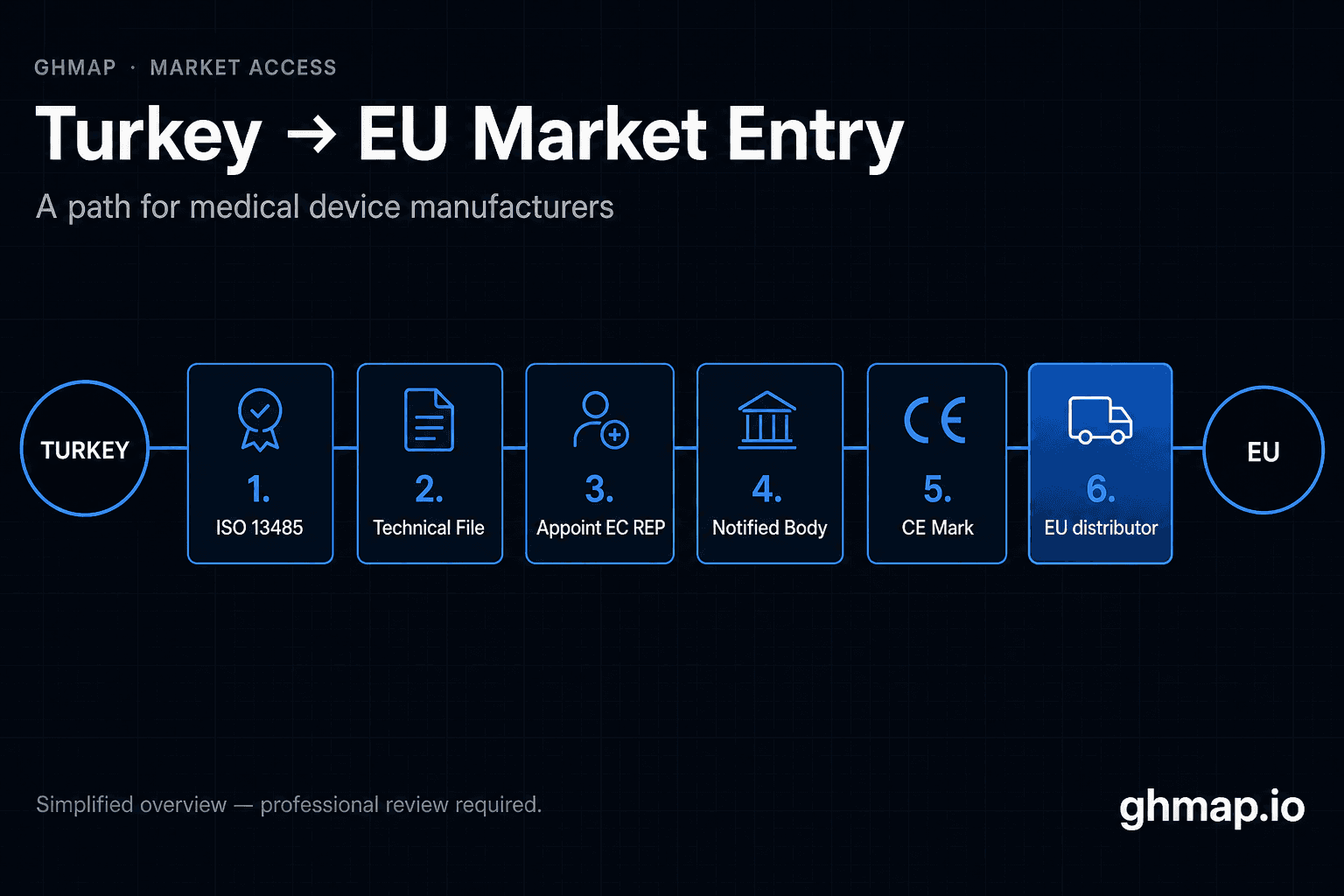
For many Turkish medical device manufacturers, the European Union is the natural first export market. Geography is close. Trade relationships already exist. Buyers and distributors often understand Turkish manufacturing capacity. For a Turkish medical device EU market plan, the real question is usually not “whether Europe matters,” but “what sequence makes the first CE-ready commercial step possible.”
This guide is general orientation. It is not legal, customs, or regulatory advice. It does not guarantee CE marking, Notified Body outcomes, distributor introductions, or sales. Professional review is required before business use.
Why the EU is often the first export market
Turkey and the European Union have a long trade relationship, including a Customs Union framework that shapes industrial goods trade in general terms. Treat that as background context only—not as a customs ruling or a promise that medical devices move without product-specific regulatory work. Devices still need the correct conformity route under European rules.
Practically, Europe offers nearby congresses, recognizable hospital systems, and distributor networks that can evaluate Turkish products without a transoceanic leap. Many teams also compare Europe with the United States early. If you are choosing pathway order, start with the comparison at CE Mark vs FDA 510(k), then return to the EU path when Europe is your beachhead.
CE Mark reality under EU MDR for a Turkish manufacturer
A CE Mark (Conformité Européenne mark) indicates that the manufacturer claims conformity with applicable European Union legislation for placing a device on the EU market. For most medical devices today, that framework is the European Union Medical Device Regulation (EU MDR)—Regulation (EU) 2017/745.
Being based in Turkey does not create a shortcut around MDR. Classification still matters. Clinical evaluation still matters. Quality-system evidence still matters. For many Class IIa, IIb, and III devices—and for certain Class I devices with measuring function or sterility—a Notified Body is involved. A Notified Body is an independent organization designated by an EU member state to assess conformity with MDR requirements.
CE Mark for Turkish manufacturers is therefore a documentation and assessment project first, and a commercial project second. Teams that reverse that order often spend money on samples and travel before the conformity story can support a serious EU buyer conversation.
ISO 13485 is the quality management system standard most device manufacturers use as a foundation for medical-device production and documentation discipline. It is not the same as a CE Mark, but weak ISO 13485 practice usually becomes visible during MDR technical-file and audit work.
Why Turkish manufacturers need an authorized representative (EC REP)
Manufacturers established outside the European Union generally need a European authorized representative—often called EC REP—to place devices on the EU market under MDR. The authorized representative is not a marketing agent. In broad terms, the role supports regulatory communication, documentation availability, and cooperation with competent authorities within the framework of the regulation and your contract.
Appointing an EC REP early avoids a common Turkey to EU medical device export failure mode: finishing much of the technical work, then discovering role, mandate, and vigilance communication gaps right before commercial launch. Ask candidates how complaints are handled, who stores which documents, and how Field Safety Corrective Actions (FSCAs) would be coordinated. Do not treat the cheapest quote as the full answer.
Building the technical file to MDR standard
The technical documentation package must support your conformity claim. Common gaps we see with Turkish SMBs are rarely about effort. They are about structure and evidence completeness:
- Device classification assumed without a written rationale that survives review.
- Risk management files that list hazards but do not connect controls to residual risk and labeling.
- Clinical evaluation reports that summarize literature without a clear device-specific argument.
- Design and manufacturing process descriptions that are too thin for the claimed device configuration.
- Post-market surveillance and vigilance plans written as templates, not operating procedures the company can run.
- Labeling and instructions for use that are incomplete for EU language and Unique Device Identification (UDI) expectations.
A usable MDR technical file is not a binder of certificates. It is a coherent story: what the device is, why the classification fits, how risks are controlled, what clinical and performance evidence supports the claims, and how post-market duties will be executed.
Checklist
EU-entry readiness checklist for Turkish manufacturers
- Device classification confirmed with a written rationale under EU MDR.
- ISO 13485 quality management system in place and usable in daily operations.
- Authorized representative (EC REP) shortlist or appointment plan with clear mandate scope.
- Technical file structured to MDR expectations, not only older directive habits.
- Clinical evaluation and risk management aligned to the exact indications you will claim.
- Labeling, instructions for use, and translation plan for target EU markets.
- UDI and traceability approach defined at a planning level.
- Notified Body strategy identified if your class/route requires one.
- Distributor strategy for the first EU country or region, with conflict checks.
- Post-market surveillance and complaint handling process owners named.
Finding EU distributors from Turkey
CE readiness without a channel plan produces expensive waiting. From Turkey, manufacturers usually combine MEDICA and specialty congresses, association introductions, competitor adjacency mapping, and direct outreach to national or regional specialists. Germany is often an early commercial conversation because of hospital scale and distributor depth. For a practical vetting framework, see how to find and vet a German distributor.
Do not grant broad EU exclusivity to a partner who only covers one country in practice. Ask for named accounts, therapeutic-area fit, vigilance capability, and references from other non-EU manufacturers. A distributor who cannot explain complaint handling is not ready for MDR-era partnership.
Practical sequencing: first, second, third
- First: lock the product configuration, classification hypothesis, and ISO 13485 operating reality. If the quality system is theater, stop and fix it.
- Second: build the MDR technical-file core and decide the EC REP model. Start Notified Body outreach when your dossier is honest enough to survive the first questions.
- Third: run distributor discovery in parallel with late-stage regulatory work, but do not sign hard exclusivity before your CE path and first-country commercial logic are clear.
Parallel work is useful. Fantasy parallelism is not. A team can map distributors while writing clinical evaluation. A team should not promise launch months that ignore Notified Body capacity.
Common mistakes specific to Turkish exporters
- Assuming Customs Union background removes the need for device-specific MDR conformity work.
- Treating Turkish registration or domestic certificates as a substitute for an EU technical file.
- Appointing an EC REP only as a mailbox, with no operational vigilance plan.
- Translating labels late, after the technical claims are already frozen poorly.
- Signing EU-wide exclusivity with a distributor who has strength in one city or one specialty only.
- Budgeting for certificates but not for deficiency responses, retesting, or post-market surveillance.
- Starting with “all of Europe” instead of one beachhead country, one department type, and one buyer motion.
Close with a controlled first step
A Turkish medical device manufacturer Europe plan succeeds when sequencing is honest: quality system, technical file, EC REP, Notified Body route where required, then a distributor motion that matches the first market. The EU can be a strong first export destination. It rewards preparation more than optimism.
If you want help mapping your product’s EU-entry path—classification, EC REP questions, technical-file gaps, and first-country distributor logic—you can book a $500 GHMAP strategy session at GHMAP pricing. Sessions are available in Turkish and English. Bring your device class, current certificates, and target EU country. We will help you structure the plan. We will not issue CE guarantees, replace qualified counsel, or deliver a product-specific Distributor Search shortlist. For that engagement, see https://www.ghmap.io/distributor-search-qualification.
Next step
If you want a product-specific EU-entry map—classification hypothesis, EC REP questions, technical-file gaps, and first-market sequencing—book a GHMAP strategy session. Sessions are available in Turkish and English. They are planning conversations, not approval services and not a product-specific Distributor Search shortlist. For evidence-based distributor search, see https://www.ghmap.io/distributor-search-qualification.
Book a $500 strategy session