
How to Find and Vet a Medical Device Distributor in Germany
A practical guide for small and mid-size manufacturers: where German distributors actually operate, how to find them, what to verify before signing, and what EU MDR expects from the distributor role.
For many small and mid-size medical device manufacturers, Germany is the first serious European commercial test. The market is large, clinically sophisticated, and procurement-driven. It is also unforgiving of a weak local partner. Choosing the right medical device distributor Germany teams will actually buy through can accelerate hospital access—or quietly stall a launch for years.
This guide is general orientation for market-entry planning. It is not legal, regulatory, or commercial advice, and it does not guarantee introductions or outcomes. Treat every checklist item as a prompt for professional review before you commit exclusivity, inventory, or regulatory reliance on a partner.
Why the German distributor decision makes or breaks EU entry
Germany rewards partners who already understand how products move from clinical interest to purchasing reality. A distributor with the wrong call points—or no call points—will burn your samples, your KOL (key opinion leader) time, and your CE Mark (Conformité Européenne mark) investment without producing revenue learning. A strong partner can open specialty departments, translate value into tender language, and keep vigilance (post-market safety monitoring and reporting) from becoming an afterthought.
EU entry is also a sequencing problem. Regulatory readiness and commercial readiness are not the same project. If you are still choosing between CE Mark under the European Union Medical Device Regulation (EU MDR) and a United States pathway, start with the pathway comparison at CE Mark vs FDA 510(k)—then return here once Germany is a concrete first-revenue hypothesis, not a slogan.
Where German distributors actually operate
“Distributor in Germany” is not one job. Partners typically operate across a few overlapping channels:
- Hospital tenders and public procurement processes, where documentation completeness and reference accounts often matter as much as product novelty.
- Group purchasing organizations (GPOs) and purchasing groups that aggregate hospital demand and influence which catalogs get preferred attention.
- Specialist dealers and therapeutic-area distributors who win through department relationships—orthopedics, cardiology, imaging, wound care—rather than broad catalog breadth.
- Clinic and outpatient channels that look smaller on paper but can be faster for certain elective or ambulatory devices.
Before you hunt names, write down which channel must produce your first twelve months of learning. A partner optimized for clinic volume may be the wrong fit for a university-hospital capital device—and the reverse is equally common.
Distributor types in Germany
Use the table below as a planning lens, not a taxonomy you must force every company into. Many firms blend models. The useful question is which model matches your device class, sales cycle, and service burden.
| Distributor type | Typical focus | Best for |
|---|---|---|
| National specialist distributor | One or a few therapeutic areas across Germany | Devices that need deep clinical selling and national account coverage |
| Regional dealer | Strong presence in a state or hospital cluster | Pilots, proof points, or products with localized service needs |
| Hospital-focused distributor | Inpatient procurement, tenders, department champions | OR, ICU, and specialty products where hospital process dominates |
| Clinic-focused distributor | Outpatient and ambulatory accounts | Faster-cycle devices with clinic economics and lighter capital burden |
| Broad-line catalog distributor | Wide SKU coverage, logistics strength | Commoditized or complementary products that win on availability and price discipline |
Where to find distributor candidates
Serious shortlists rarely come from a single LinkedIn search. Manufacturers usually combine several discovery surfaces:
- Trade fairs such as MEDICA (one of the world’s largest medical trade fairs, held in Düsseldorf) and specialty congresses where distributors reveal which products they can actually explain on a booth floor.
- Industry associations, chamber referrals, and country desks that can point to categories of partners—without replacing your own diligence.
- Competitor and adjacency mapping: who already sells into the departments you need, and who is missing a product like yours.
- Warm introductions through clinicians, hospital procurement contacts, or peer founders who have lived the post-contract reality—not just the pitch.
- Structured networks and market-access platforms. GHMAP’s distributor-oriented workflows at https://www.ghmap.io/use-cases/distributors are one way to organize partner criteria before outreach.
When you find distributor Germany candidates, capture the same fields for every name: therapeutic focus, geography, hospital vs. clinic bias, approximate portfolio conflicts, and who would own your product day to day. A messy spreadsheet is fine. An undocumented memory is not.
How to vet a medical device distributor in Germany
Vetting is where optimism meets operational evidence. You are not looking for the partner who sounds most enthusiastic about your device. You are looking for the partner who can prove access, process, and follow-through in the accounts that matter.
Checklist
What to verify before signing a German distributor
- Therapeutic-area fit: they already sell into your specialty with adjacent—not conflicting—products.
- Existing hospital or clinic relationships: named accounts, not vague “strong network” claims.
- Regulatory and vigilance capability: who handles complaints, Field Safety Corrective Actions (FSCAs), and traceability under EU MDR.
- Commercial coverage model: national, regional, hospital-focused, or clinic-focused—and whether that matches your first-revenue plan.
- References from other manufacturers: ask what happened after month six, not only during launch week.
- Exclusivity terms: territory, channel, performance gates, and exit conditions if milestones are missed.
- Minimum order or inventory commitments: who carries stock risk, and what happens to slow-moving units.
- Training and clinical support capacity: who educates users, and how often.
- Conflict check: competing lines, bandwidth, and whether your SKU will be a priority or a brochure filler.
- Contract clarity on pricing authority, tender participation, and who owns customer relationships if the agreement ends.
Score each item as verified, partial, or unknown. Unknown is not neutral—it is a reason to slow down. Many weak partnerships begin with “we’ll figure out vigilance later.”
What a distributor legally owes under EU MDR
Under EU MDR, “distributor” is not only a sales label. It is an economic operator role with obligations that sit alongside the manufacturer’s responsibilities. In plain terms, a distributor making a device available on the market must support conformity, traceability, storage/transport conditions, and cooperation on complaints and competent-authority requests—within the scope defined by the regulation and your contractual setup.
You should not treat a blog summary as a compliance checklist. Have qualified regulatory counsel confirm how roles are allocated in your case—especially if an importer, authorized representative, or logistics partner is also in the chain. What you can do in diligence is ask operational questions: Who verifies labeling and instructions for use before release? How are Unique Device Identification (UDI) and lot/serial traceability handled? What is the complaint escalation path? How quickly can they quarantine stock?
If a candidate cannot describe vigilance workflows without improvising, that is information. Market access in Germany without post-market discipline is not market access—it is deferred risk.
Red flags worth taking seriously
- Pressure for broad exclusivity before any named account plan, pilot site, or performance metrics exist.
- Inability to name hospitals, departments, or procurement routes relevant to your device class.
- Portfolio conflicts they dismiss as “not a real issue,” especially close competitors with higher margins.
- No clear owner for vigilance, complaint handling, or field actions.
- References that only praise personality, never execution after the first stocking order.
- Requests that you bypass documentation, CE status reality, or training requirements to “move faster.”
- Vague territory definitions that make it hard to measure coverage—or to exit cleanly.
How to structure the first conversation
A good first meeting is short, specific, and mutual. You are interviewing each other. Bring a one-page product brief: indication, classification hypothesis, CE status, target departments, service needs, and what “success in twelve months” means in units or accounts—not slogans.
Ask the distributor to walk one recent launch: who bought, how long tendering took, what failed, and what they would not take on again. Then map your device onto that story. If the conversation stays abstract—“we cover all of Germany”—you do not yet have a partner thesis. If they propose a narrow beachhead (for example, three university hospitals in one specialty) with clear owners and a training plan, you may have the start of one.
Close the first call with written next steps: documents to exchange, reference calls, a conflict check, and a date to decide whether a second meeting is warranted. Speed is useful. Ambiguity is expensive.
Close the loop before you sign
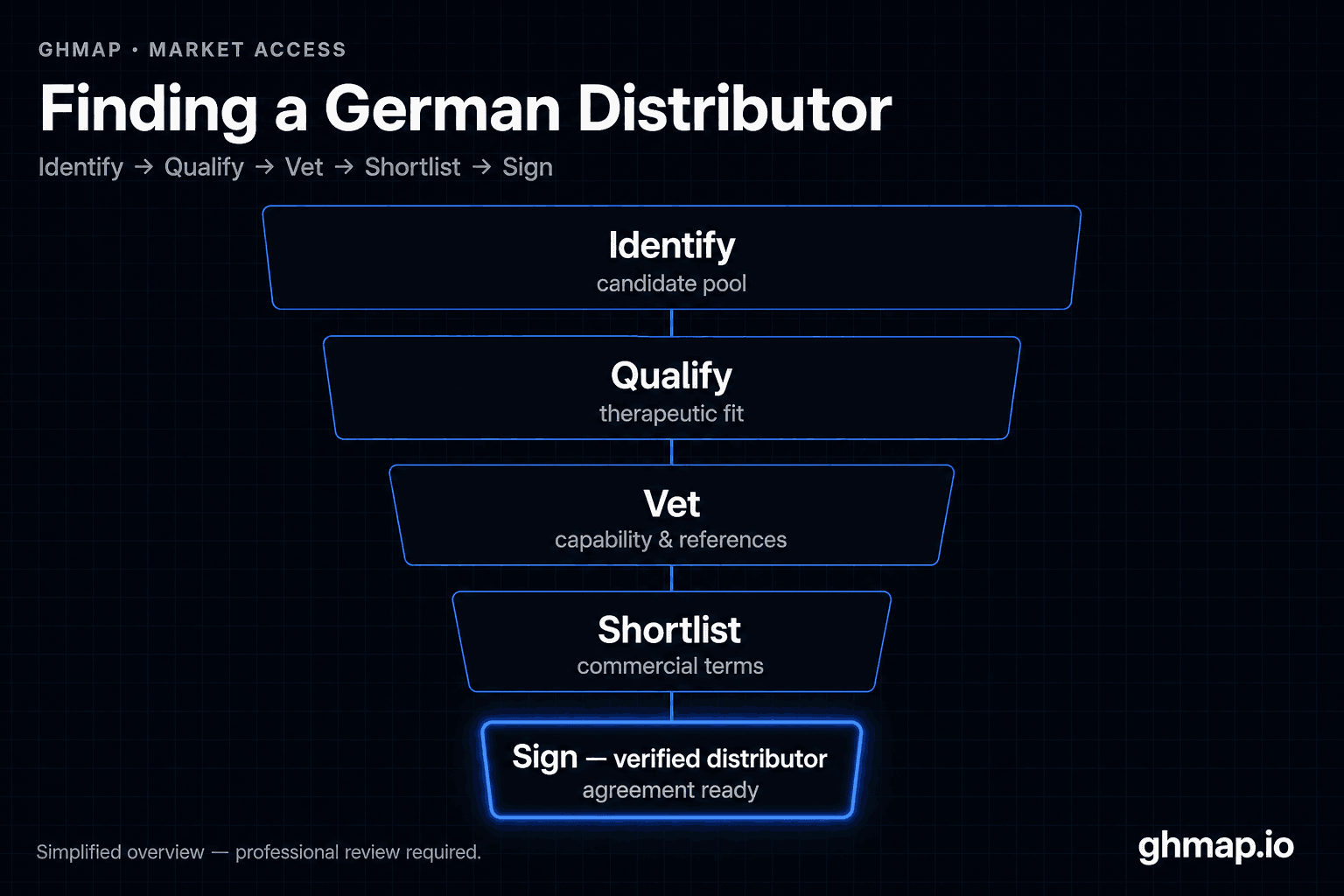
Finding a medical device distributor in Germany is less about collecting business cards and more about narrowing a funnel: Identify → Qualify → Vet → Shortlist → Sign. Each stage should remove names for concrete reasons—channel mismatch, conflict, weak vigilance, or commercial terms that transfer all risk to you.
When your shortlist is real, pressure-test commercial terms with the same rigor you apply to regulatory files. Exclusivity without performance gates is not partnership; it is a parking space. Inventory commitments without demand signals are not confidence; they are cash conversion risk.
If you want help turning this general framework into a planning conversation—target departments, conflict checks, and the questions to ask before you grant exclusivity—you can book a $500 GHMAP strategy session at GHMAP pricing. Bring your device class, CE status, and the German accounts you most need to learn from. We will help you organize the decision; we will not pretend a conversation replaces counsel, guarantees a signed distributor, or delivers a product-specific Distributor Search shortlist. For that engagement, see https://www.ghmap.io/distributor-search-qualification.
Next step
If you want planning help on German channel logic, conflict questions, and what to verify before exclusivity, book a GHMAP strategy session. Sessions are planning conversations with clear limits: no product-specific distributor shortlist, no introduction guarantees, and no substitute for qualified legal or regulatory counsel. For a product-specific evidence-based shortlist, use Distributor Search & Qualification at https://www.ghmap.io/distributor-search-qualification.
Book a $500 strategy session