
The Real Timeline and Cost of Entering the German Medical Device Market
A stage-by-stage planning view of German medical device market entry cost and timing—from CE readiness and Notified Body assessment through distributor onboarding, hospital evaluation, reimbursement, and launch.
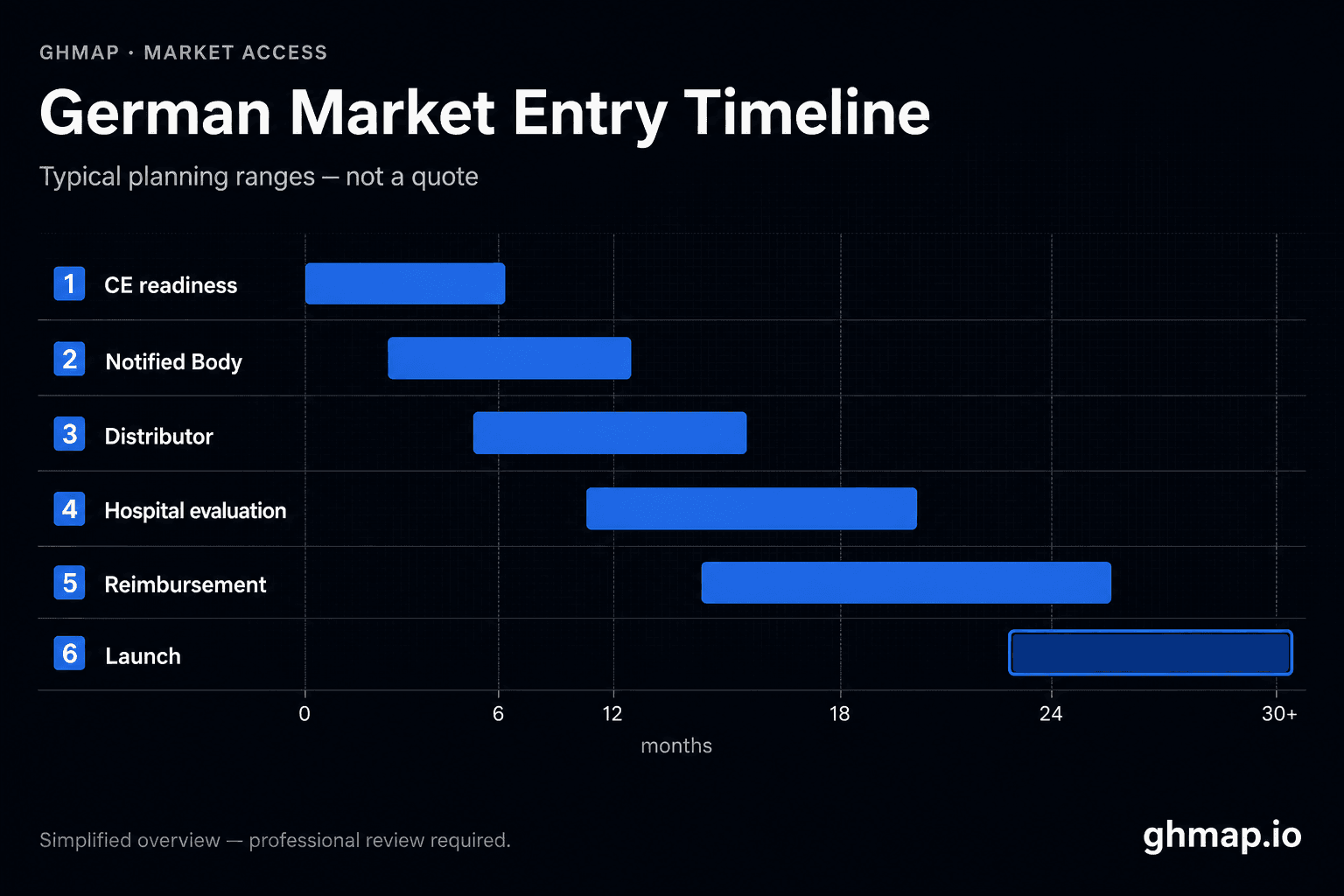
When manufacturers ask about German medical device market entry cost, they often want one number and one date. Germany does not work that way. Cost and time are a sequence of stages—some sequential, some overlapping—each with its own drivers, bottlenecks, and cash needs. A Class IIa device with a clean clinical evidence story and an existing distributor relationship will not look like a novel Class III device that still needs Notified Body capacity and a reimbursement strategy.
This article reframes the question into a planning model: typical ranges by stage, what moves those ranges up or down, and the hidden costs teams forget until month nine. Every figure below is a general planning estimate for orientation only—not a quote, commitment, or legal fact. Professional review is required before business use. For country-level context beyond this guide, see GHMAP’s country intelligence at GHMAP country intelligence.
Think in stages, not a single sticker price
A useful German medical device market entry plan separates six stages: regulatory and CE readiness under the European Union Medical Device Regulation (EU MDR); Notified Body conformity assessment where required; distributor onboarding; hospital evaluation and tenders; reimbursement filing—including Gemeinsamer Bundesausschuss (G-BA, the Federal Joint Committee) pathways where relevant; and commercial launch. Some cash leaves the company early (technical documentation, testing, translation). Some arrives later as opportunity cost while tenders and evaluation drag.
Treat the table as a sequencing tool. Your real calendar is the critical path through the stages you cannot skip for your device class and commercial model.
German market-entry stages: typical time and cost ranges
| Stage | Typical time range | Typical cost range (USD) | Main variable |
|---|---|---|---|
| Regulatory / CE readiness (technical documentation, QMS, clinical evaluation) | Often ~3–12+ months depending on starting maturity | Often ~$40k–$250k+ all-in for many SMB programs (testing, consulting, documentation) | Device class, evidence gaps, quality-system maturity |
| Notified Body assessment (where required) | Often ~6–18+ months after dossier readiness; queues vary | Often ~$25k–$150k+ in fees and response cycles for many routes | Notified Body capacity, deficiency cycles, novelty |
| Distributor onboarding | Often ~1–6 months to a workable operating rhythm | Often ~$5k–$40k+ (training, samples, launch kits, travel) before meaningful sales | Channel fit, exclusivity terms, inventory expectations |
| Hospital evaluation & tenders | Often ~3–18+ months from first champion to repeatable orders | Often ~$10k–$80k+ in samples, demos, clinical support, and bid effort | Department access, reference sites, tender complexity |
| Reimbursement filing / G-BA where relevant | Often ~6–24+ months when a formal pathway applies; some devices use existing codes | Often ~$15k–$200k+ depending on evidence and consulting intensity | Whether coding already exists; evidence burden; pathway type |
| Launch (first commercial sales motion) | Often overlaps prior stages; first revenue commonly ~12–30+ months from a cold start | Working capital for stock, service, and local support—highly device-specific | Sales cycle length and post-sale service burden |
These ranges intentionally overlap. A manufacturer with CE Mark already in hand skips much of the early regulatory cash—but still faces distributor, hospital, and reimbursement work. A company that starts cold should plan for concurrency: documentation while mapping distributors; Notified Body dialogue while building clinical champions; reimbursement analysis while tenders teach you what buyers actually ask for.
Stage-by-stage: what you are actually paying for
The ranges above are planning envelopes. The sections below explain what each stage typically consumes—so you can tell fee spend from calendar risk before you build a board model.
Regulatory and CE readiness
CE Mark (Conformité Européenne mark) readiness under EU MDR is usually the first large spend for companies that are not already certified for the product they want to sell. Budget time for technical documentation, risk management, clinical evaluation, labeling, and a quality management system that can survive scrutiny. Lower-risk Class I routes can be shorter; Class IIa, IIb, and III routes typically front-load more evidence and process discipline.
Notified Body assessment
A Notified Body is an independent organization designated by an EU member state to assess conformity with MDR requirements for many device categories. Capacity, scheduling, and deficiency responses often dominate the EU MDR timeline more than manufacturers expect. The invoice is not only the assessment fee—it is also consulting time, retesting, and calendar slip while the team answers questions.
Distributor onboarding
Germany rarely rewards a “ship boxes and hope” model. Onboarding includes training, samples, complaint/vigilance handoffs, and commercial terms. The wrong partner looks cheap until exclusivity freezes your channel. For how to find and vet partners before you spend this stage’s budget, see how to find and vet a German distributor.
Hospital evaluation and tenders
Hospital evaluation is where clinical interest becomes purchasing reality—or does not. Expect demo units, in-service training, department champion time, and tender documentation. Public procurement cycles can stretch timelines even when clinicians like the product. This stage’s cost is often underestimated because it is spread across travel, samples, and staff time rather than one invoice.
Reimbursement and G-BA where relevant
Not every device needs a novel reimbursement campaign on day one. Some enter through existing procedure or product coding and compete on clinical preference and hospital economics. Others require a structured path involving evidence generation and engagement with institutions such as the G-BA. Statutory health insurance in Germany (gesetzliche Krankenversicherung, often discussed in planning shorthand alongside broader payer context) shapes what hospitals can sustainably buy. Treat “reimbursement” as a branching decision tree, not a single fee.
Launch
Launch is less a ribbon-cutting than a working-capital event: inventory positioning, local service readiness, complaint handling, and a sales rhythm that can survive the first slow quarter. First revenue timing commonly lands in a broad 12–30+ month window from a true cold start—faster when CE status, channel, and coding already exist; slower when novelty stacks on every stage.
What drives the range up or down
- Device class and novelty: higher risk and fewer predicates/comparators usually mean more evidence, more questions, and more calendar.
- Clinical evidence readiness: a complete evaluation story compresses CE and reimbursement uncertainty; gaps expand both.
- Notified Body capacity and dossier quality: incomplete files create expensive ping-pong.
- Whether CE Mark already exists for the exact configuration you will sell in Germany.
- Channel maturity: an identified distributor with hospital access shortens commercial stages; a cold search lengthens them.
- Reimbursement pathway: existing codes versus evidence-heavy novel pathways change both cost and how long medical device Germany launches take.
Hidden costs manufacturers forget
- Translation and labeling: German instructions for use, packaging, marketing claims review, and updates when the device changes.
- European authorized representative (often called EC REP): many non-EU manufacturers need a contractual authorized representative arrangement—budget for fees and information-flow obligations.
- Importer / economic-operator coordination: role clarity across manufacturer, authorized representative, importer, and distributor under EU MDR.
- Post-market surveillance and vigilance systems: complaint intake, trend analysis, Field Safety Corrective Actions (FSCAs), and competent-authority cooperation are ongoing costs, not launch-week chores.
- Tender participation: bid preparation, reference letters, pricing models, and sometimes local service commitments.
- Training and clinical support: repeated in-services beat a single kickoff call for most specialty devices.
- Sample and demo fleet attrition: lost, damaged, or obsolete demo units are a real line item.
- Change control after launch: a “small” design or labeling change can reopen regulatory and commercial workstreams.
A realistic total picture
If you need a planning envelope—not a promise—many small and mid-size manufacturers should think in bands rather than points. A relatively straightforward Class IIa-style program with CE work still ahead, a competent Notified Body path, and a hospital-led commercial motion often lands in a broad all-in planning band on the order of mid–high six figures USD across regulatory, channel, and early commercial stages over roughly 18–30+ months. Cleaner starting points (CE already held, strong distributor, existing coding) can compress both cash and calendar. Novel, high-risk, or reimbursement-heavy programs can exceed those bands substantially.
Resist averaging someone else’s anecdote into your board deck. Ask instead: Which stages are already done? Which are on the critical path? Which costs are fees versus staff time versus working capital? That is how German medical device market entry stops being a mythic lump sum and becomes a managed sequence.
If you want help turning these general ranges into a product-specific German timeline and cost estimate—device class, evidence gaps, distributor assumptions, and reimbursement branch—you can book a $500 GHMAP strategy session at GHMAP pricing. Bring your current CE status, target departments, and what “first revenue” means in units or accounts. We will help you structure the plan; we will not issue quotes disguised as guarantees or replace qualified counsel.
Next step
If you want a product-specific German timeline and cost estimate—device class, evidence gaps, channel plan, and stage sequencing—book a GHMAP strategy session. Sessions are planning conversations: no quotes disguised as guarantees, and no substitute for qualified legal or regulatory counsel.
Book a $500 strategy session