Medical Device Registration in Kenya: A Practical Guide
How Kenya medical device registration works with the Pharmacy and Poisons Board (PPB): device classes, Local Authorized Representative rules, evaluation routes, official fees, real-world timelines, and post-market duties.
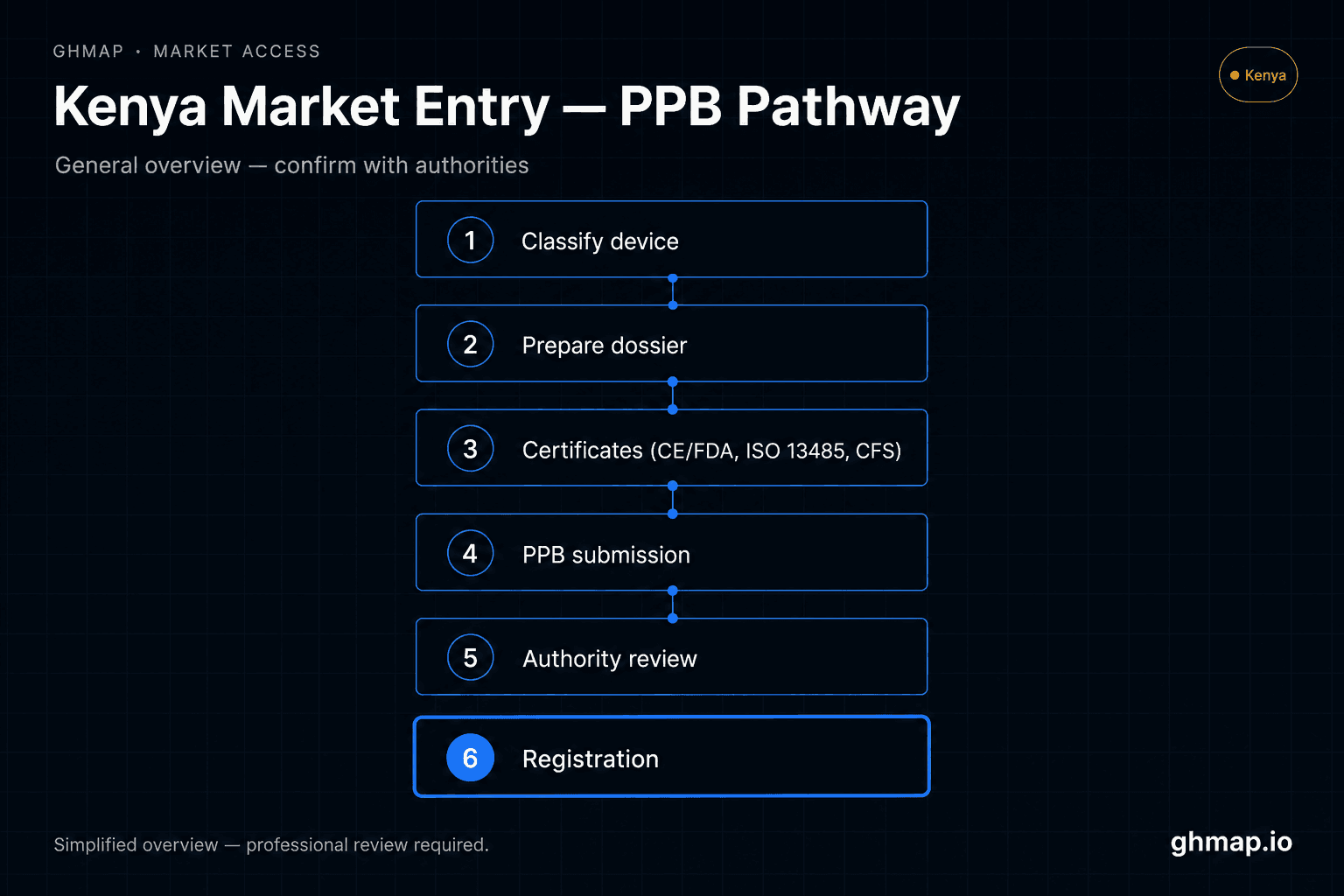
Kenya has one of the most structured medical-device regulatory systems in Africa. If you want to sell, import, or distribute medical devices in Kenya, they must be registered with the country's regulator—the Pharmacy and Poisons Board (PPB)—before they can be marketed. Here is how the process works, step by step.
This guide summarizes the PPB's registration guideline and related official sources. Requirements, portals, fees, and document lists change—confirm every detail with the PPB and a qualified local regulatory advisor before you commit a calendar or a budget. It is not a filing manual and does not guarantee registration or import outcomes. Professional review is required before business use.
The regulator: Kenya's Pharmacy and Poisons Board (PPB)
The PPB is Kenya's national authority for health products, established under the Pharmacy and Poisons Act (Cap 244). The Health Act 2017 makes it unlawful to manufacture, import, distribute, or market a medical device in Kenya without prior PPB approval. The core rulebook is the PPB's Guidelines for Registration of Medical Devices including In-Vitro Diagnostics (HPT/PER/HTPGUD/011), and applications are filed through the PPB's PRIMS online portal.
Step 1 — Classify your device (Class A, B, C, or D)
Kenya uses a risk-based classification aligned with the international IMDRF model. The manufacturer determines the risk class, based on factors like intended use, invasiveness, duration of contact, and whether the device contains medicinal substances. Do not assume a European or U.S. class transfers automatically without confirmation—classification affects dossier depth, evidence expectations, and fee level.
| Class | Risk level | Examples |
|---|---|---|
| A | Low | Bandages, hospital beds |
| B | Low–moderate | Urinary catheters, dental prosthetics |
| C | Moderate–high | Long-term contact lenses |
| D | High | Pacemakers, implantable defibrillators, heart valves |
In-vitro diagnostics follow the same A–D ladder with their own classification rules (for example, HIV blood-donor screening sits in the higher classes). A useful planning habit: write a one-page classification memo with intended use, invasive/active characteristics, and the class you believe applies—then have it checked locally before you build the full dossier. Wrong class early is cheaper than wrong class after submission.
Step 2 — Appoint a Local Authorized Representative (mandatory)
Before the PPB grants any approval, you must name a Local Authorized Representative (LAR) in Kenya. Foreign manufacturers cannot skip this step—it is a hard requirement, not an option:
- Only one LAR per product, and it must be the same on the device label and the Declaration of Conformity.
- The LAR must be registered with the PPB.
- The LAR acts as your primary contact with the authority, keeps the technical file available for inspectors, reports adverse events, and manages field safety corrective actions.
Step 3 — Choose your evaluation route
PPB offers several evaluation routes depending on risk class and whether your device is already approved elsewhere. Devices with strong reference-agency histories can qualify for dramatically faster routes:
| Route | Who qualifies | Typical review pace |
|---|---|---|
| Full Evaluation | Devices with no prior approvals from PPB reference agencies | ~6–12 months |
| Abridged Evaluation | Devices approved by at least two PPB reference agencies | ~3–6 months |
| Expedited (EBR / ECR / EDR) | Two to three reference-agency approvals plus a clean multi-year market history (requirements vary by class) | ~1–3 months |
| Immediate Class B (IBR) | At least three reference-agency approvals, marketed for at least four years in two reference jurisdictions, and no safety issues globally in the last three years | Registered on submission, email confirmation within ~48 hours |
PPB's independent reference regulatory agencies, per its guideline, are Health Canada, Japan's MHLW, the U.S. FDA, Australia's TGA, EU notified bodies, Swissmedic, and Ireland's HPRA. Their approvals qualify you for the abridged or expedited routes—they do not replace PPB registration itself.
Note the PPB's official process ceilings are wider than real-world experience: screening within 90 working days and evaluation within 24 months. PPB guidance also states that the timeline for regulatory approval ultimately remains the authority's prerogative. Plan conservatively and start early.
Step 4 — Compile the dossier and submit
Applications are prepared in the Common Submission Dossier Template (CSDT), consistent with the international GHTF summary technical documentation format, and submitted through the PRIMS portal. Devices must be grouped correctly—single device, family, system, or group. Bundling devices that differ in technology, risk class, or purpose into one application leads to rejection after a long queue—and the fees are not refunded.
Checklist
Class A dossier — commonly required documents
- Letter of authorization
- Device labeling, including label and instructions for use
- Certificate of analysis
- Information on sterilization method(s) and its validations, if applicable
- Regulatory approval from the product's country of origin
- QMS conformance evidence (ISO 13485 or equivalent)
Step 5 — Review, lab testing, and decision
PPB screens the application for completeness, then evaluates it. For IVDs—and some other products such as condoms—PPB requires in-country performance testing at its Quality Control laboratory before approval: an IVD that fails the lab criteria is not approved. On-site audits of manufacturing facilities may also be required for higher-risk devices. If queries are raised, the clock depends on how fast you respond, and the certificate of registration is issued within 7 days of the approval decision.
Fees — PPB official schedule (per class, per manufacturer, per product)
| Fee | Imported products | Locally manufactured |
|---|---|---|
| Class A registration | USD 100 | USD 50 |
| Class B registration | USD 200 | USD 50 |
| Class C & D registration | USD 1,000 | USD 100 |
| Variation of a registered device | USD 200 | USD 50 |
| Annual retention — Class A & B | USD 50 | USD 50 |
| Annual retention — Class C & D | USD 300 | USD 50 |
The fee figures above come directly from the PPB's registration guideline, whose fee basis is set in Kenya's 2022 statutory fee rules. Fast-track review is available for qualifying Class B, C, and D applications under PPB's fast-track guideline (HPT/PER/GUD/041)—confirm the current fast-track fee with the PPB before budgeting, as reported figures vary.
After approval: registration validity, retention, and changes
The certificate of registration is valid for five years (PPB guideline, section 2.12). In an emergency or in the public interest, the PPB can at its discretion issue a certificate valid for two years. To keep market authorization active, every registered device must be retained annually in the PPB database—pay the annual retention fee inside the year-end window; failure to retain can lead to suspension and cancellation of the registration.
Any change to a registered device—design, materials, labeling, intended use—must be notified to the PPB; some changes need prior approval. Manufacturers and their local representatives must report adverse events and carry out field safety corrective actions when required.
Commercial reality: registration is not adoption
Kenya's commercial path often runs through private hospitals, specialty clinics, and distributor relationships long before any broad public reimbursement theory matures. Cash-pay and insured private segments can move faster than public tender cycles—but they still demand training, service, and credible pricing. An in-country distributor or importer is not optional window dressing for most foreign manufacturers: they help with local representation, logistics, hospital access, and sometimes vigilance communication.
A registered product still needs a channel, a pricing story, and a buyer motion. If your team collapses “registered” into “paid,” revisit the reimbursement and payment gap framing at medical device reimbursement gap. For country-level sequencing context beyond this guide, see GHMAP's regulatory pathways at GHMAP regulatory pathways and country intelligence at GHMAP country intelligence.
Frequently asked questions
Do I need a local partner to register a device in Kenya? Yes. A PPB-registered Local Authorized Representative is mandatory before any approval is granted.
Can I rely on my CE mark or FDA clearance? Partially. PPB uses a reliance model: prior approvals from reference agencies (FDA, EU, TGA, Health Canada, and others) qualify you for the abridged or expedited routes, which are much faster. They do not replace PPB registration.
How long does Kenya medical device registration take? It depends on the route: roughly 6–12 months for a full evaluation, 3–6 months for abridged, and 1–3 months for expedited—based on consultant reports. PPB's official ceilings are wider, and IBR routes register on submission. Plan conservatively and start early.
What does registration cost? USD 100 (Class A) to USD 1,000 (Class C/D) per product for imported devices, plus annual retention fees. Fees are non-refundable.
Are IVDs treated differently? IVDs follow the same A–D classification, but PPB requires in-country performance testing of IVD samples at its Quality Control laboratory before approval.
Next step
If you want to assess Kenya entry for your specific product—classification hypothesis, dossier readiness, import document list, and distributor logic—book a GHMAP strategy session. Sessions are planning conversations, not filing services or approval guarantees.
Book a $500 strategy session