
Why Regulatory Approval Isn’t Enough: The Reimbursement Gap That Kills Device Launches
Regulatory clearance or CE marking answers whether you may sell. Medical device reimbursement—coding, coverage, and payment—answers whether anyone can sustainably buy. Most small manufacturers budget for the first and discover the second too late.
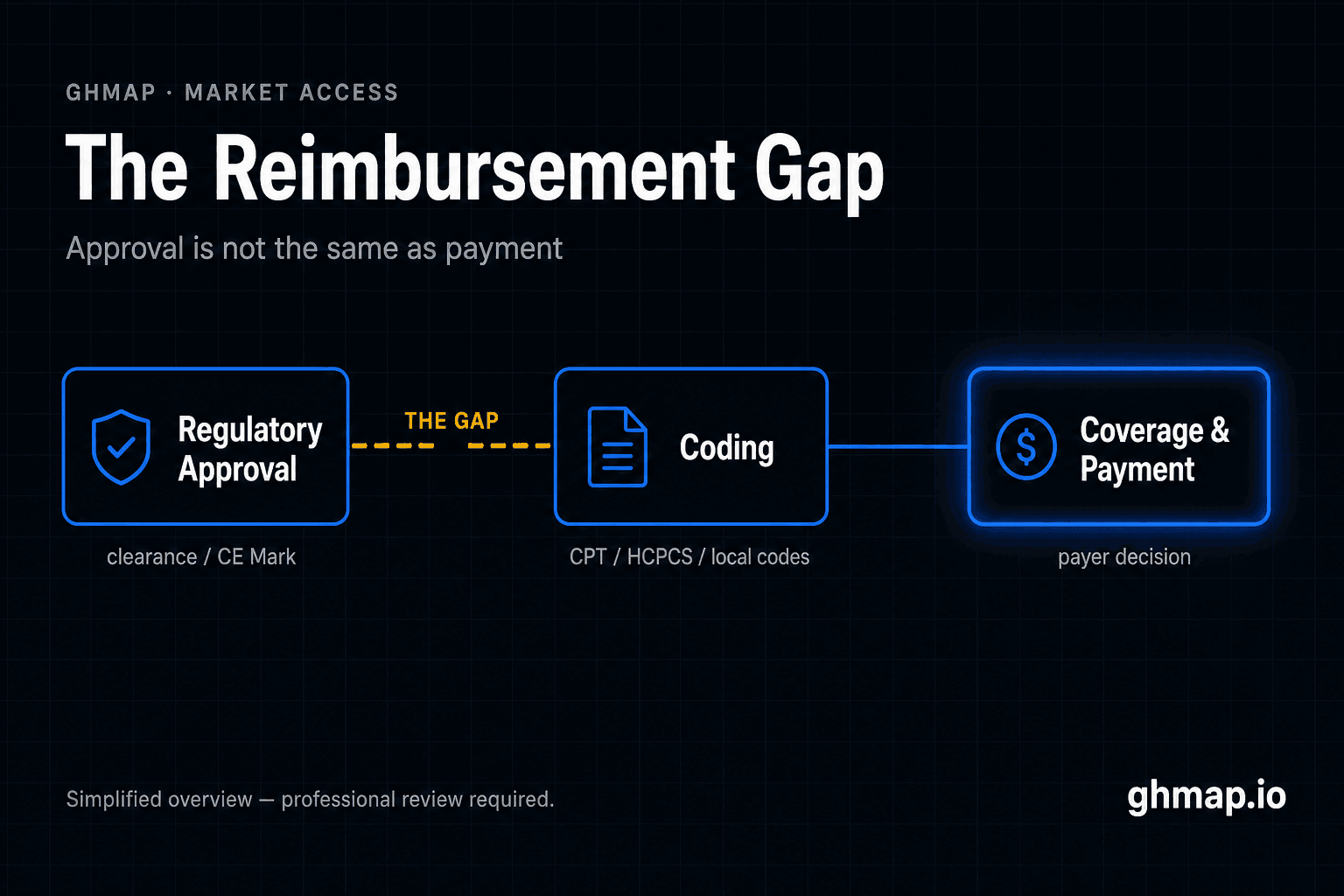
Here is the trap that still surprises capable founders: the device is cleared by the U.S. Food and Drug Administration (FDA), or it carries a CE Mark (Conformité Européenne mark) under the European Union Medical Device Regulation (EU MDR)—and still earns nothing. Hospitals do not stock it. Distributors stall. Finance asks why “approved” did not become “adopted.” The short answer is that medical device reimbursement is a different problem from regulatory permission to sell.
This article is general orientation for market-access planning. It does not predict coding outcomes, coverage decisions, or payment. It does not imply that GHMAP can secure reimbursement. Professional review is required before business use.
Three hurdles founders collapse into one word
In early pitch decks, “approval” often stands in for the entire commercial unlock. In reality, most launches must clear three separable hurdles:
- Regulatory approval or marking: May we place this device on the market under the rules of a jurisdiction?
- Coding: Is there a recognized billing or procedure identity so claims can be submitted in a structured way?
- Coverage and payment: Will a payer, hospital budget holder, or tender system actually fund use at a sustainable rate?
You can win the first and still lose the second or third. That sequence—not a mysterious lack of “market education”—is why many medical devices fail after approval.
| Hurdle | What it answers | Who decides (typical) | Typical failure mode |
|---|---|---|---|
| Regulatory approval / marking | Is the device allowed on the market for stated indications? | Regulators and designated assessors (e.g., FDA; Notified Bodies under EU MDR) | Treating clearance/CE as proof of demand or payment |
| Coding | How is the procedure or product identified on claims and in hospital systems? | Code-maintenance bodies and local coding authorities (varies by market) | No specific code, forced misuse of unrelated codes, or unusable miscellaneous pathways |
| Coverage & payment | Will someone pay—and enough to sustain use after discounts and costs? | Payers, health technology assessment (HTA) bodies, hospitals, and tender authorities | Code exists but coverage is denied, restricted, delayed, or priced below viability |
What “reimbursement” actually means
In everyday founder language, reimbursement is a single checkbox. In market access, it is usually a stack:
- Coding: the language of claims—identifiers that let providers describe what was done or supplied.
- Coverage: the policy decision that a use is eligible for payment under defined conditions.
- Payment: the amount, rules, and mechanics that determine cash actually received after adjustments.
A payer is any organization that funds care—public insurers, private insurers, national health systems, or self-paying institutions depending on the market. Health technology assessment (HTA) is the structured evaluation of clinical and economic value that often informs coverage. Coding without coverage is paperwork without a check. Coverage without adequate payment is permission to lose money carefully.
How the gap shows up differently by market
The labels change; the separation of hurdles does not. Country pages in GHMAP’s country intelligence library at GHMAP country intelligence are a useful place to ground which institutions matter before you build a model.
United States: CMS, CPT, HCPCS, and payer coverage
In the United States, manufacturers often track the Centers for Medicare & Medicaid Services (CMS) because Medicare policy and payment systems influence broader practice—even when commercial payers decide independently. Procedure coding frequently involves Current Procedural Terminology (CPT) codes maintained with American Medical Association processes, while Healthcare Common Procedure Coding System (HCPCS) codes are commonly discussed for products, supplies, and certain services. None of that automatically equals coverage. A code can exist while local coverage determinations, medical policies, prior authorization, or site-of-service rules still block routine use.
FDA clearance or approval answers a regulatory question. It does not compel a private payer—or CMS—to treat your device as a covered benefit at a viable rate. Planning medical device coding and coverage as parallel workstreams is how sophisticated teams avoid confusing “listed in a fee schedule conversation” with “hospitals will buy.”
Germany: G-BA, statutory insurance, and hospital economics
In Germany, CE marking is necessary market permission for many devices, not a payment decision. Benefit and method questions may involve the Gemeinsamer Bundesausschuss (G-BA, the Federal Joint Committee) and the wider statutory health insurance system (gesetzliche Krankenversicherung). Hospital purchasing still has to reconcile clinical interest with budget reality, tender rules, and existing procedure economics. For a stage-based view of how reimbursement sits inside a longer German entry calendar, see German medical device market entry cost and timeline.
Other markets: cash-pay, tenders, and social insurance systems
In some markets, early revenue is cash-pay or privately funded while public pathways mature. In others, hospital tenders dominate access even when a product is legally marketable. Social insurance systems—such as Turkey’s Sosyal Güvenlik Kurumu (SGK)—illustrate another pattern: listing, pricing, and procurement logic can matter as much as the regulatory certificate. The lesson is portable: map who pays, under what code or catalog identity, and with what evidence expectation, before you treat regulatory success as launch readiness.
Why small manufacturers get blindsided
Small and mid-size teams usually budget for the visible mountain: testing, consultants, Notified Body or FDA fees, and the celebration of the approval letter. They under-budget the quieter mountain: evidence for economic and clinical value, coding strategy, payer or HTA dossiers, real-world data plans, key opinion leader (KOL) pathway work, and the months of hospital evaluation where “interesting” never becomes a purchase order.
- Board timelines assume revenue starts at clearance.
- Distributor conversations stall when there is no payment story for the buyer.
- Clinical champions cannot get past value-analysis or procurement committees.
- Miscellaneous or temporary coding pathways prove too fragile for scale.
- Evidence generated for regulatory safety/performance does not answer payer questions about comparative value.
None of this means reimbursement is impossible. It means reimbursement vs regulatory approval is a sequencing mistake when treated as the same work package.
What to do about it early
The practical fix is unglamorous: put market access reimbursement on the critical path beside regulatory, not after it.
- Write the payment hypothesis in one page: who pays, in which setting, using which coding theory, under what coverage logic.
- Separate “must have novel code,” “can use existing code with evidence,” and “cash-pay or tender-first” as explicit options—not vibes.
- Align clinical evidence plans with both regulator and payer/HTA questions where feasible; do not assume one study serves both.
- Ask distributors and hospital advisors what blocks purchasing today for adjacent products—not only whether they like your device.
- Build a kill-criteria list: if coding or coverage pathways look non-viable in the beachhead market, decide whether to change market order before burning the launch budget.
- Keep language honest with investors: regulatory permission is a gate; it is not revenue.
Early planning will not guarantee coverage. It will prevent you from discovering the gap only after the regulatory invoice is paid and the cash runway is short.
Approval opens the door; payment decides if anyone walks through
Regulatory success is necessary in most serious markets. It is rarely sufficient. The reimbursement gap—between legal permission to sell and a durable coding, coverage, and payment path—is where otherwise strong devices stall. Treat those as three hurdles with different decision-makers, different evidence, and different failure modes. Then sequence your calendar and budget accordingly.
If you want help mapping the reimbursement questions for your product and target market—without treating a blog post as a coverage strategy—you can book a $500 GHMAP strategy session at GHMAP pricing. Bring your device class, target country, and current regulatory status. We will help you structure the questions and evidence gaps. We will not secure coding, guarantee coverage, or promise payment.
Next step
If you want to map the reimbursement questions for your product and target market—coding hypotheses, coverage decision-makers, and evidence gaps—book a GHMAP strategy session. Sessions are planning conversations. GHMAP does not secure or guarantee coding, coverage, or payment.
Book a $500 strategy session