
Market Entry Sprint vs. DIY: What Actually Goes Into a Medical Device Launch Plan
You can build a medical device launch plan yourself. This article shows what that work actually includes—and when a reviewed Market Entry Sprint is worth the time and money.
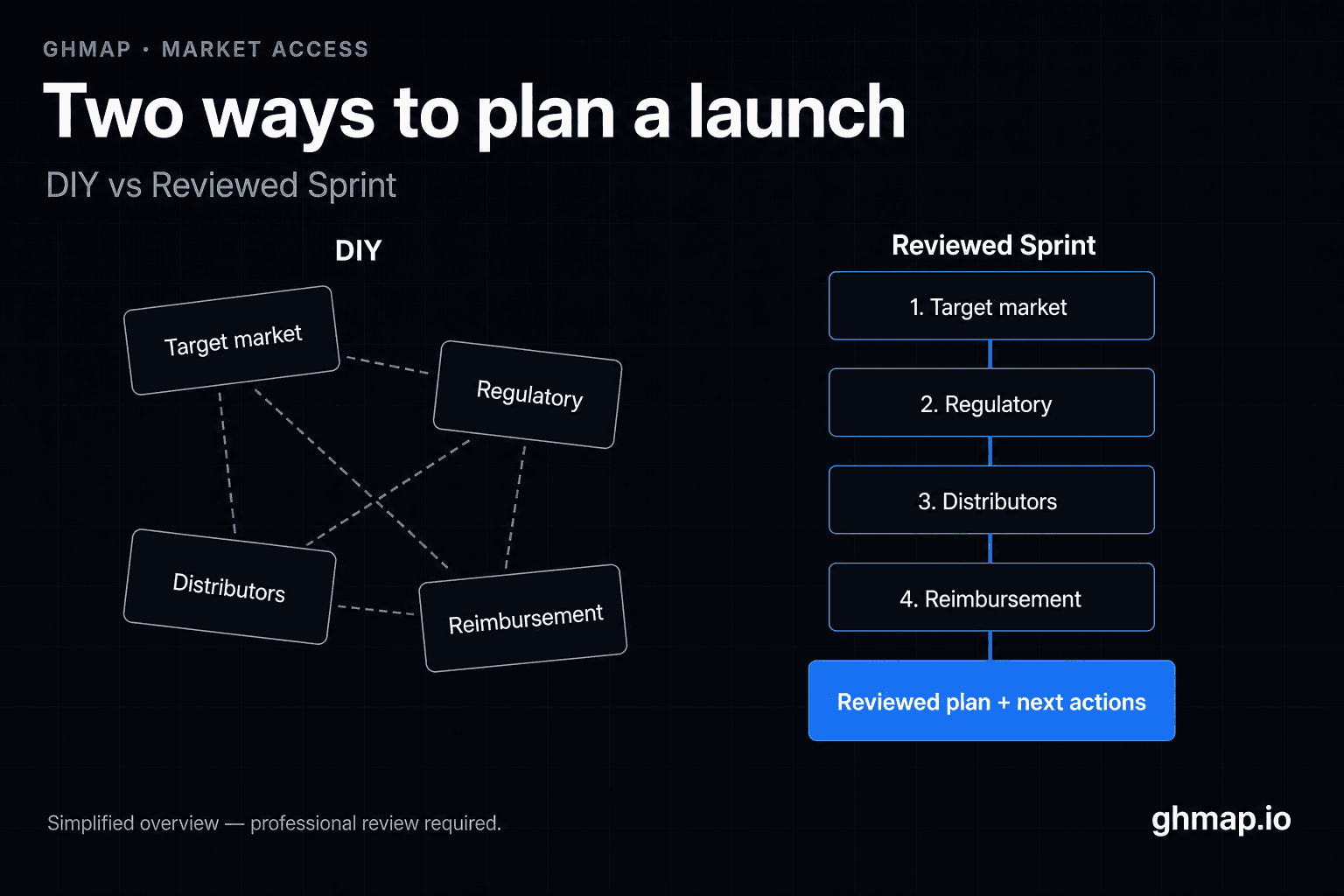
You can write a medical device launch plan yourself. Many capable founders do. This article is not an argument that DIY market access is foolish. It is a clear inventory of what “doing it right” actually includes—so you can decide, with less romance and less pressure, whether to keep the work in-house or bring in a reviewed structure.
A launch plan is not a slide titled “Germany Q3.” It is a sequenced set of decisions about market, regulation, evidence, partners, buyers, payment logic, calendar, and risk. Miss the sequence and you can still look busy. You just spend longer learning the same lessons.
What actually goes into a market-entry plan
A useful market entry plan medical device teams can execute usually covers eight components. Each one can be light or heavy depending on device class and country—but skipping one without naming the skip is how plans become fiction.
- Target market selection: which country or cluster first, and why that beachhead unlocks learning or revenue.
- Regulatory pathway: CE Mark (Conformité Européenne mark) under the European Union Medical Device Regulation (EU MDR), U.S. Food and Drug Administration (FDA) routes, or local registration—chosen with classification hypotheses stated.
- Evidence and documentation readiness: technical file maturity, clinical evaluation status, labeling, and quality-system proof such as ISO 13485 (the medical-device quality management standard).
- Distributor strategy: whether you need a partner, what “good” looks like, and what documents you will show in meeting one.
- Hospital / tender approach: who buys, how evaluation works, and what a first account shortlist means in practice.
- Reimbursement questions: coding, coverage, and payment hypotheses—or an explicit cash-pay / tender-first model.
- Timeline and budget: stage ranges, working capital, and what “done” means for the next ninety days.
- Risk assessment: the three ways this plan fails, and the kill criteria that stop you pouring cash into a dead path.
If you want a concrete sense of how timeline and cost ranges look for one major market, the Germany stage overview at German medical device market entry cost and timeline is a useful companion—not a universal template.
What each component takes if you do it yourself
DIY is rarely “a weekend.” It is usually founder and regulatory-affairs time spread across weeks, plus waiting time for answers from Notified Bodies, consultants, distributors, and hospitals. A Notified Body is an independent organization designated by an EU member state to assess conformity with MDR requirements for many device routes.
- Target market selection: days to weeks of secondary research, customer calls, and honest constraint mapping (cash, certificates, language, travel).
- Regulatory pathway: hours with guidance documents plus expert review if classification is non-obvious; months if you discover the wrong pathway late.
- Evidence readiness: often the largest DIY block—gap analysis against the dossier you actually have, not the one you wish you had.
- Distributor strategy: outreach, vetting, and conflict checks; easy to underestimate calendar and soft skills.
- Hospital / tender approach: specialty knowledge, sample logistics, and relationship time that does not show up in a spreadsheet.
- Reimbursement questions: research that can exceed regulatory work in some markets; or a clear decision that payment is private/tender-first.
- Timeline and budget: iterative—and only as good as the assumptions feeding it.
- Risk assessment: short if you are ruthless; endless if every risk becomes a new workstream.
None of this means DIY is inferior. It means DIY market access has a real cost in attention. Founders who already know the beachhead market and have a strong regulatory lead often move well alone. Founders who are inventing the plan while also fundraising and shipping product usually underestimate the coordination tax.
Where DIY commonly goes wrong
- Analysis paralysis: endless country comparisons with no named first buyer motion.
- Wrong first market: choosing the “biggest” market without a distributor path or evidence fit.
- Missing documents: deals stall when Certificate of Free Sale (CFS), labeling, or quality certificates are treated as afterthoughts.
- Regulatory optimism: treating CE or FDA status as the whole medical device go-to-market plan.
- Partner theater: signing exclusivity before performance gates or therapeutic fit are clear.
- Budget fiction: planning fees but not deficiency cycles, samples, travel, or working capital.
These failure modes are not moral failures. They are structure failures. The work is multi-threaded; without an explicit sequence, the loudest task wins.
What a structured / reviewed approach adds
A reviewed approach—whether that is an internal tiger team with a forced agenda, or an external Market Entry Sprint—mainly adds three things: speed of framing, a second expert set of eyes, and sequencing discipline.
Speed of framing means turning scattered notes into a plan with owners and dates. A second set of eyes catches classification wishful thinking, thin evidence stories, and commercial terms that look fine until month six. Sequencing means deciding what must be true before you spend on the next stage—so regulatory, distributor, and hospital work do not fight each other for the same week.
GHMAP’s reviewed planning work is designed to produce clarity and next actions—not guarantees. You can inspect a sample of the output style at GHMAP sample brief before you decide anything. That is the point: see the artifact, then judge whether the format helps your team.
DIY vs. Reviewed Sprint — an honest comparison
| Dimension | DIY | Reviewed Sprint |
|---|---|---|
| Time investment | High founder / RA calendar load; often spread over weeks of stop-start work | Compressed framing period; still requires your product facts and decisions |
| Expertise required | You must already have—or quickly learn—regulatory, commercial, and country judgment | External reviewer adds pattern recognition; you remain accountable for decisions |
| Risk of costly mistakes | Higher if the team is new to the market or pathway; lower if veterans own the plan | Lower for sequencing and blind-spot checks; does not eliminate execution risk |
| Speed to first action | Can be fast if the team already agrees; slow if debates never resolve | Usually faster to a written next-action list with explicit assumptions |
| Cost | Lower cash outlay; higher opportunity cost of founder/RA time | Higher cash outlay for a session or sprint; can save rework if used early |
When DIY is fine vs. when help pays for itself
DIY is often fine when: you already have a named beachhead country, a defensible regulatory pathway hypothesis, an internal owner who has launched before, and a distributor or hospital conversation that is already real. In that case, a clean internal checklist may be enough.
Help tends to pay for itself when: the team disagrees on first market, classification is ambiguous, documents are incomplete, or you are about to grant exclusivity / spend six figures on testing and travel. The value is not “someone else does market access for you.” The value is fewer expensive wrong turns before you commit.
How to plan medical device market entry is ultimately a governance choice. Choose the lightest process that produces a written plan with assumptions, owners, and kill criteria. Anything less is hope with a logo.
If you want a reviewed plan or a second opinion on your own, a $500 GHMAP strategy session or a Market Entry Sprint is available at GHMAP pricing. To see the kind of structured output before you buy, review the sample brief at GHMAP sample brief. Bring your device class, target country hypothesis, and current certificate status. We will help you organize next actions. We will not guarantee registration, introductions, or revenue.
Next step
If you want a second opinion on your own plan—or a reviewed Market Entry Sprint with clear next actions—start at GHMAP pricing. Sessions and sprints are planning support, not approval services and not outcome guarantees. Prefer to see the output first? Review the sample brief before you buy.
See pricing & sample brief