
5 Documents to Prepare Before Approaching a Medical Device Distributor
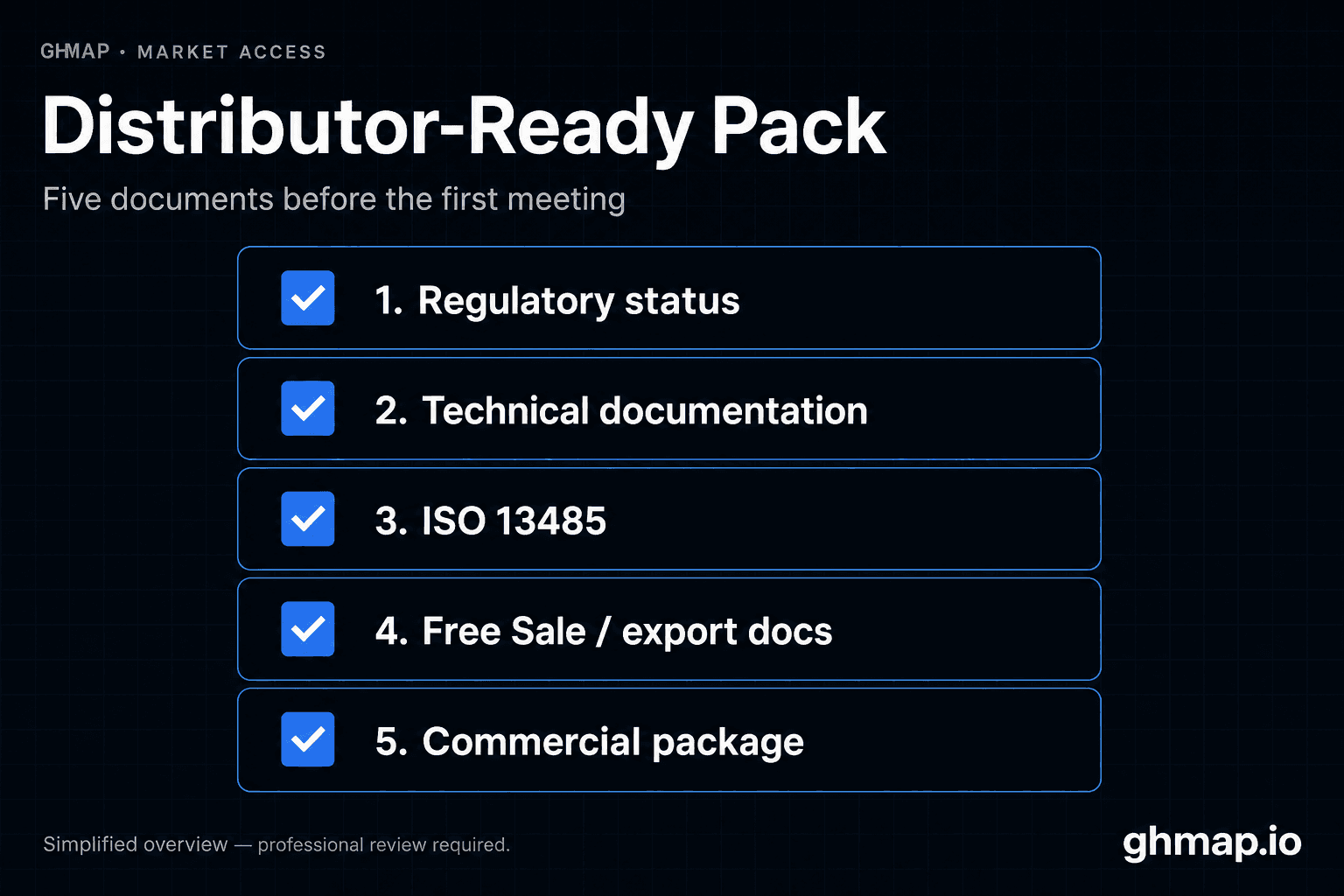
A distributor-ready pack beats a pitch deck alone: regulatory status, technical documentation, ISO 13485, free-sale/export documents, and a clear commercial package—assembled before the first meeting.
Distributors decide fast. Not because they are careless—because they have seen too many incomplete manufacturer kits. A clear set of documents before approaching distributor conversations signals that you understand regulatory reality, quality discipline, and commercial mechanics. It shortens diligence. It reduces “send me everything” email chains. It makes exclusivity talks less speculative.
Exact requirements vary by product, distributor, and country. Confirm case by case. This guide is general orientation for assembling a practical pack—not a legal checklist. Professional review is required before business use.
1. Regulatory status summary — CE Mark / FDA clearance and classification
What it is: a one- to two-page summary of where the device stands legally—CE Mark (Conformité Européenne mark) status under the European Union Medical Device Regulation (EU MDR) where relevant, U.S. Food and Drug Administration (FDA) clearance or other pathway status if claimed, and the device classification you are working under. Include certificate numbers, scope, and expiry dates when they exist.
Why the distributor cares: they need to know whether they can sell tomorrow, in six months, or only after someone else’s regulatory work finishes. Ambiguous “we’re CE” language is a trust tax.
What a strong version looks like: current status, markets in scope, classification rationale in plain language, and open gaps stated honestly (for example, “Class IIa CE certificate active; U.S. 510(k) not filed”). Attach key certificate pages as an appendix.
Common mistake: claiming broader status than the certificates support, or mixing “in progress” with “cleared.” Distributors forgive timelines. They do not forgive fiction.
2. Product technical documentation / commercial spec sheet
What it is: a commercial-facing technical pack—indications, key specifications, materials, sterilization/shelf life where relevant, compatible accessories, and the claims you will actually support. This is not your full MDR technical file. It is the version a sales and clinical specialist can review without drowning.
Why the distributor cares: they must explain the device to hospitals, clinics, and value-analysis committees. If your pack cannot survive a specialist’s first read, your device will not survive their pipeline.
What a strong version looks like: consistent product naming, clear intended use, competitive positioning without unsupported outcome claims, and a short FAQ on training and service. Keep marketing language aligned with regulatory claims.
Common mistake: sending an engineering dump, or a brochure with claims the regulatory file cannot defend. Either one slows the meeting.
3. Quality certification — ISO 13485
What it is: evidence that your quality management system has been certified to ISO 13485, the international standard for medical-device quality management systems. Include the certificate, scope, sites covered, and validity dates.
Why the distributor cares: ISO 13485 is a shorthand for operational seriousness. It does not replace market authorization, but many partners treat its absence as a stop sign—especially for implantable, sterile, or higher-risk devices.
What a strong version looks like: certificate plus a short note on which legal manufacturer entity and manufacturing sites are in scope. If you use contract manufacturers, say so cleanly.
Common mistake: sending an expired certificate, or an ISO 9001 certificate and hoping nobody notices the difference.
4. Certificate of Free Sale and/or relevant export documents
What it is: trade and market-status documents the importer or distributor may need to move product across borders. A Certificate of Free Sale (CFS) is a common request—typically a statement that the product is legally marketed in its home or reference market. Related papers can include legalizations, translations, or other export certificates depending on destination.
Why the distributor cares: deals stall when logistics and registration teams discover missing papers after commercial interest peaks. A partner who sees you already understand CFS timing trusts your launch calendar more. For a plain-language CFS explainer, see Certificate of Free Sale medical device guide.
What a strong version looks like: current CFS (if available), issuer identity, validity window, and a one-line note on legalization status for the target country. If you do not have it yet, state the request timeline instead of pretending.
Common mistake: confusing CFS with a CE certificate or ISO 13485 certificate. Different documents answer different questions.
5. A clear commercial package — pricing, MOQ, margins, and evidence materials
What it is: the business layer distributors actually negotiate—pricing logic, minimum order quantity (MOQ), indicative margin structure, sample policy, training plan, and the marketing/clinical evidence materials they can use with customers. Clinical evidence here means the materials appropriate for commercial education—not a promise of outcomes and not clinical advice.
Why the distributor cares: even a strong regulatory story dies if the economics are opaque. Partners need to know whether they can stock, sell, and support the line without guessing.
What a strong version looks like: suggested channel pricing bands (clearly marked as indicative), MOQ options, sample and demo rules, exclusivity principles at a high level, and a short list of available leave-behinds (IFU summaries, clinical summaries with source status, hospital FAQ). Keep numbers directional until diligence justifies detail.
Common mistake: refusing all commercial detail “until NDA forever,” or promising worldwide exclusivity in meeting one with no performance gates. For how vetting works on the other side of the table—especially in Germany—see how to find and vet a German distributor.
Checklist
Distributor-ready pack — five documents to assemble
- Regulatory status summary: CE Mark / FDA pathway status, classification, certificate scope and dates.
- Commercial technical documentation / spec sheet fit for specialist review (not the full technical file dump).
- ISO 13485 certificate with scope, sites, and validity.
- Certificate of Free Sale and/or other export documents required for the target market—or a dated plan to obtain them.
- Commercial package: pricing logic, MOQ, margin framework, samples/training, and marketing/clinical evidence materials.
How to assemble a distributor-ready pack
Keep one master folder with a two-page cover index. Version-date every PDF. Separate “share in meeting one” from “share under NDA.” Lead with the regulatory summary and commercial package; keep certificates in an appendix. Before outreach, ask the distributor what their onboarding checklist requires for your device class and country—then reconcile gaps instead of guessing.
Optional next step for teams that want a leave-behind: request the five-document checklist as a one-page PDF so your internal owners can execute against the same list. Exact capture forms can be wired later; the value is a shared pack definition.
Showing up prepared does not guarantee a signed agreement. It does tell a serious distributor you will not waste their hospital relationships. In market access, that is often the difference between a polite meeting and a working pilot conversation.
If you want help building a distributor-ready pack for a specific target market—document gaps, sequencing, and what to present in the first meeting—you can book a $500 GHMAP strategy session at GHMAP pricing. Bring your device class, current certificates, and the country you want first. We will help you structure the pack. We will not invent certificates or guarantee introductions.
Next step
If you want to build a distributor-ready pack for a specific target market—document gaps, order of preparation, and what to show in meeting one—book a GHMAP strategy session. Sessions are planning conversations, not filing or approval services.
Book a $500 strategy session