
How Wound Care Devices Get to Market: A Case Study Approach
An illustrative, composite walkthrough of wound care device market entry—from first-market choice and regulatory pathway through documentation, distributors, hospital pilots, reimbursement questions, and launch.
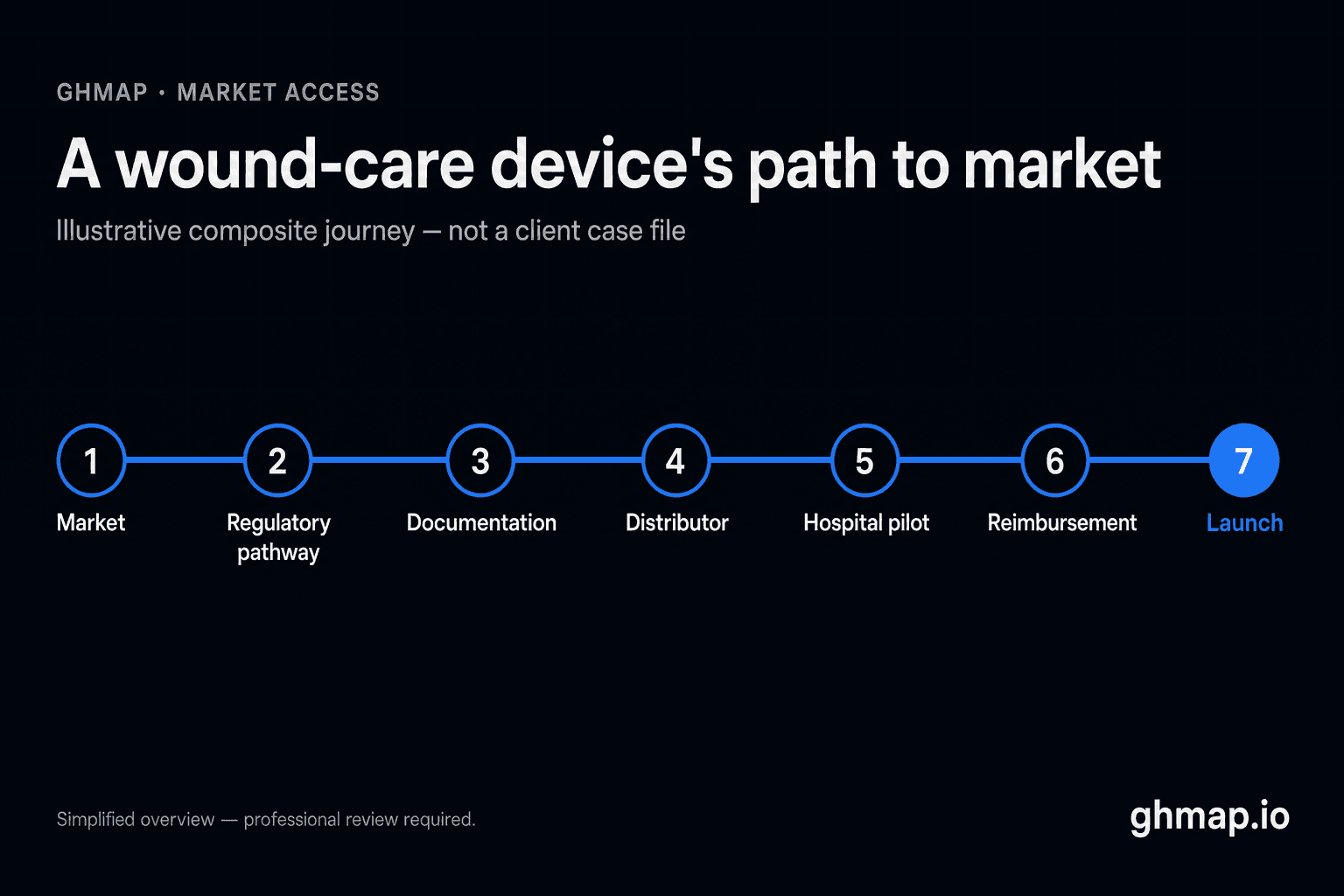
Wound care is a useful lens for medical device case study thinking. Clinical need is concrete. Product classes are often well-defined. Hospital evaluation and distributor behavior are real, not theoretical. That makes wound care device market entry a clear way to show how market access actually unfolds—stage by stage—without pretending every product follows one script.
GHMAP’s work focuses heavily on wound-care organizations and the market-access decisions around them. What follows is an illustrative, composite walkthrough of how a wound-care product’s first-market journey typically unfolds. It is not a record of a specific client engagement. It does not invent confidential results, quotes, or commercial figures. Treat it as a planning narrative that requires professional review before business use.
Checklist
Seven stages of a wound-care path to market (scan view)
- 1. Market — Choose the first country or cluster with a named buyer motion.
- 2. Regulatory pathway — Confirm CE Mark or FDA 510(k) (or local registration) and device class.
- 3. Documentation — Assemble technical file, ISO 13485, and export documents such as a Certificate of Free Sale.
- 4. Distributor — Identify and vet partners who can reach the right departments.
- 5. Hospital pilot — Convert clinical interest into evaluation and early use.
- 6. Reimbursement — Separate coding, coverage, and payment from regulatory permission.
- 7. Launch — Ship, train, monitor complaints, and protect the registered scope.
Stage 1: Choosing the first market
In our composite journey, a mid-size manufacturer with an advanced wound-dressing portfolio faces a familiar fork: enter a high-visibility European market first, or start in a faster-learning market such as an East African hub. The team writes a one-page beachhead memo: where the earliest paying accounts are likely to sit, which language and labeling burden they can fund, and whether a distributor relationship already exists.
They do not choose “the biggest market.” They choose the market that produces the next dollar of learning—clinical feedback, tender language, or distributor commitment—without exhausting cash. For East Africa, that might mean confirming Pharmacy and Poisons Board (PPB) expectations early. For Germany or another EU market, it means planning CE Mark work and hospital access together.
The memo also names what would falsify the choice: no named clinic champion within ninety days, no importer willing to own vigilance handoffs, or a labeling burden the company cannot fund. Kill criteria keep Stage 1 from becoming a permanent debate.
Stage 2: Confirming the regulatory pathway and classification
Next comes pathway honesty. A CE Mark (Conformité Européenne mark) under the European Union Medical Device Regulation (EU MDR) is a different project from an FDA 510(k)—a U.S. Food and Drug Administration premarket notification route that often rests on substantial equivalence to a predicate device. Wound-care products can look “simple” commercially and still carry classification and evidence surprises.
The composite team drafts a classification hypothesis, lists the indications they will actually claim, and decides whether Europe or the United States is first. They use a structured comparison—not hallway anecdotes. A practical starting point for that fork is CE Mark vs FDA 510(k). Whatever they choose, they write the open gaps in plain language: clinical evaluation depth, biocompatibility package, or predicate logic.
Stage 3: Assembling documentation
With a pathway chosen, the work becomes documentation discipline. The technical file (or 510(k) evidence pack) must match the product configuration that will ship. ISO 13485—the medical-device quality management system standard—needs to be real in operations, not only as a PDF on a shared drive. Export conversations often add a Certificate of Free Sale (CFS), which typically speaks to home-market free-sale status and varies by issuing body and destination.
In the composite story, the painful discovery is timing: certificates that “exist somewhere” are not the same as certificates that are current, correctly scoped, and legalized for the importer’s checklist. Teams that treat documentation as a last-mile chore usually discover the gap after a distributor has already asked for exclusivity timelines.
A practical habit: keep a version-dated document index—technical summary for commercial review, full technical file for regulatory work, and a shareable certificate appendix. Distributors should not receive an unstructured dump that mixes engineering drafts with uncontrolled marketing claims.
Stage 4: Identifying and vetting distributors
Wound care device commercialization rarely skips the channel. Hospitals want training, stock reliability, and a local contact for complaints. The composite manufacturer builds a shortlist by therapeutic fit—advanced wound care, not a broad catalog of unrelated lines—then vets hospital relationships, vigilance capability, and conflict risk.
They refuse EU-wide exclusivity from a partner who only proves strength in one region. They ask for named accounts and references from other manufacturers. For a practical vetting framework in a demanding European market, see how to find and vet a German distributor. The lesson transfers: channel quality is part of wound care market access, not a post-regulatory errand.
Stage 5: Hospital evaluation and pilot interest
Regulatory permission does not equal department adoption. In the composite journey, a wound clinic champion likes the product, but value-analysis and procurement still ask for IFU clarity, training plans, sample policy, and evidence summaries with source status labeled honestly (“example only,” “to be verified,” or cited).
A pilot is defined tightly: which indication, which ward, which success criteria, who owns stock, and how adverse events or complaints escalate. Without that definition, “pilot interest” becomes free sampling with no learning. With it, the manufacturer collects operational feedback that strengthens both the dossier and the commercial story.
Stage 6: The reimbursement question
Here many wound-care launches stall—even after clearance or CE marking. Reimbursement is not one checkbox. It is usually coding, coverage, and payment as separate hurdles. In Germany, benefit and method questions may involve institutions such as the Gemeinsamer Bundesausschuss (G-BA, the Federal Joint Committee). In other markets, early revenue may be cash-pay, private insurance, or tender-driven.
The composite team writes a one-page payment hypothesis: who pays in the beachhead setting, under what coding theory if any, and what evidence would be required later. They do not confuse hospital enthusiasm with a durable funding path. For the structural gap between approval and payment, see medical device reimbursement gap.
Stage 7: Launch and early monitoring
Launch is less a ribbon-cutting than an operating system going live: labeled product, trained users, complaint intake, traceability, and change control. The composite manufacturer aligns the first shipment to the registered or cleared scope, confirms importer/distributor roles, and schedules early clinical support visits instead of disappearing after the purchase order.
Post-market surveillance is treated as part of bringing a wound care product to market—not an afterthought. Field questions about exudate management, dressing change frequency, or skin integrity become both product learning and vigilance signals. The team tracks whether the launch is producing the learning they claimed in Stage 1.
What this journey teaches
Three lessons repeat across wound-care market-entry journeys. First, sequence beats slogans: market, pathway, documents, channel, hospital, payment, then launch. Second, honesty about gaps is a commercial asset—distributors and hospitals forgive timelines more readily than fiction. Third, regulatory success is necessary and rarely sufficient; payment and adoption have their own calendars.
Your product will not match this composite beat-for-beat. Class, claims, geography, and evidence maturity move the critical path. The value of a case-study approach is not copying someone else’s calendar. It is forcing your team to name the stage you are actually in—and the stage you are pretending to skip.
If you work in wound care, use the seven stages as a shared language with co-founders, regulatory leads, and commercial partners. Agreement on the stage reduces meetings that re-argue markets while documents and channel work remain unfinished.
If you want help mapping your own product’s journey—first market, regulatory pathway, documentation gaps, distributor questions, and reimbursement hypotheses—you can book a $500 GHMAP strategy session at GHMAP pricing. Bring your device class, current CE/FDA/ISO status, and the country you want first. We will help you structure the stages. We will not invent outcomes or replace qualified counsel.
Next step
If you want to map your own product’s journey—first market, pathway, documentation gaps, and distributor questions—book a GHMAP strategy session. Sessions are planning conversations for wound-care and other device teams, not approval services and not outcome guarantees.
Book a $500 strategy session